Lightweight detectors used to study and endure Mars extremes

Mars, with its dusty landscapes and thin atmosphere, has long intrigued scientists. Its climate is shaped by dust storms, transient clouds and phenomena such as dust devils(opens in new window), holding vital clues to the planet evolution. Yet, studying these atmospheric features has proven challenging. The tools researchers use on Earth, including LiDAR(opens in new window) systems that analyse aerosols and clouds, are too bulky and power-hungry for Martian missions. To date, only one LiDAR system has ever made it to the Martian surface – the one aboard NASA’s Phoenix mission in 2008. While it provided valuable data, its performance was limited in certain aspects, such as its restricted range (maximum observable height of about 10 km) and reduced functionality during daylight operations.
Challenges on the path to Mars
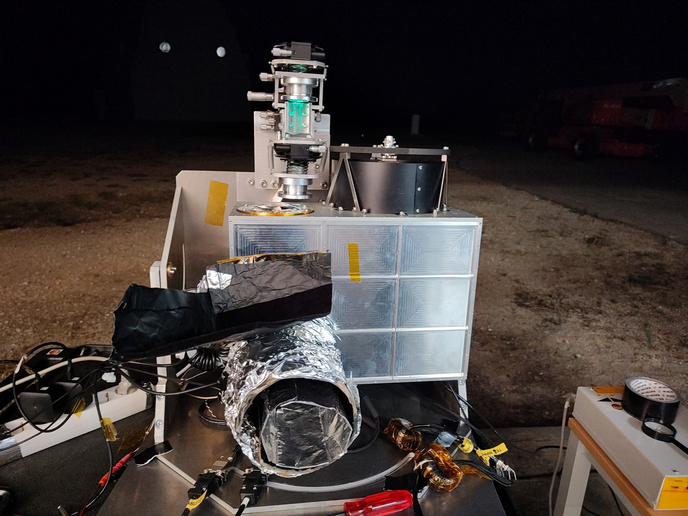
The EU-funded MiLi(opens in new window) set out to create a compact, low-power LiDAR system capable of detailed observations specifically designed for Martian missions. “The problem with traditional LiDAR systems is that they require precise thermal control to keep their components aligned and functioning. On Mars, where temperatures swing dramatically, this would be nearly impossible without a complete redesign,” notes project coordinator Isaias Carrasco-Blazquez. To tackle this, the project team revisited the technology from the ground up, focusing on advancements that would make the system smaller, lighter and more energy-efficient. A key breakthrough was replacing traditional light sources with laser diode stacks, which consume less power and produce less heat. Specialised optics capable of precise beam collimation were developed to ensure the laser beams remained properly focused. Another innovation was introducing silicon photomultipliers as detectors. While these sensors generate slightly higher noise levels than traditional detectors, they require far less power and offer a broader detection range. Ultimately, the team developed ceramic materials which, with a controlled coefficient of thermal expansion, help maintain system alignment even as temperatures fluctuate.
A small system with big potential
Carrasco-Blazquez explains, “MiLi’s prototype, weighing just 6 kg and consuming 15 W, has demonstrated its capabilities in field tests, achieving ranges of over 25 km. The prototype and enabling technologies reached a technology readiness level (TRL) of 4, with further progress anticipated.” What sets MiLi apart is its ‘2β + 1δ’ LiDAR configuration, which allows it to gather more detailed data than ever before. This set-up can measure the amount of light scattered by particles as well as depolarisation and colour ratio. These measurements provide critical information about particle size, shape and type in the atmosphere. “The system’s compact design opens new possibilities, such as studying dust devils laterally with unprecedented detail. For the first time, scientists could analyse the speed, opacity and particle size distribution of these swirling phenomena,” adds Carrasco-Blazquez.
Building the future of Martian research
While MiLi has achieved remarkable progress, there is still room for improvement before reaching TRL 6, the level required for a flight mission. Key areas include advancing ceramic manufacturing to produce lighter, more complex components; conducting additional environmental tests on commercial-off-the-shelf components; improving radiation hardness of silicon photomultiplier detectors; and performing thermal vacuum tests on the entire LiDAR system to ensure instrument alignment across Mars’s extreme temperature ranges. The impact of the MiLi project extends beyond its immediate achievements. A project partner is now contributing to an initiative sponsored by the European Space Agency, aiming to deploy a LiDAR system aboard a spacecraft to study Mars’s atmosphere from orbit. While this mission is still in its early stages, it highlights the broader significance of MiLi’s innovations.