A cable-free solution for data transfer in satellites

Satellite design faces a bottleneck inside the spacecraft: heavy, complex wired harnesses. In a typical satellite, these hand-assembled cables and shielding represent up to 15 % of the total dry mass, with data lines making up around half. Because these harnesses are difficult to standardise, making changes late in the design process is notoriously costly and labour-intensive. In compact platforms such as CubeSats and microsatellites, this cabling severely restricts internal space, complicates assembly and testing, and locks components into rigid placements. Radio links could eliminate physical wires but introduce electromagnetic interference, while standard photodiode-based optical sensors struggle to distinguish signals from multiple transmitters simultaneously. The EU-funded OCC4SAT(opens in new window) project helped to partially replace traditional cables by introducing optical camera communication(opens in new window) (OCC) as a lightweight, wireless alternative for internal data transfer. Instead of relying solely on physical cables or radio waves, OCC uses short-range optical links powered by small LED transmitters and camera-based receivers. “Because camera sensors naturally capture spatial layout and colour spectrums, a single camera can serve as a central optical access point, receiving data from multiple LED transmitters without needing a separate cable for each communication link,” explains project coordinator Jose Rabadán-Borges. “The camera separates multiple simultaneous data streams by position and wavelength using spatial and wavelength division multiple access schemes(opens in new window), allowing high-density optical communication without electromagnetic interference.”
Digital tools and physical prototypes for optical communications
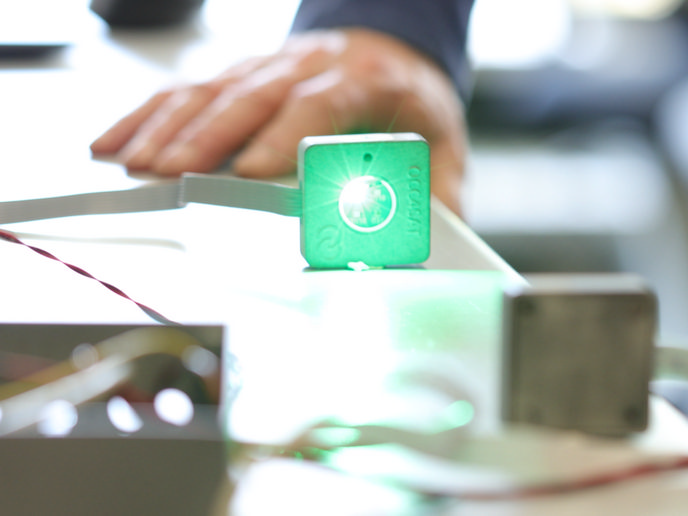
To prove this concept, OCC4SAT developed an integrated technology chain built around two demonstrator outputs. First, a digital simulator models light propagation, ray tracing, surface reflections, camera noise and synthetic image generation. This allows engineers to test link placement and evaluate both line-of-sight and reflected optical paths before building hardware. This digital tool accelerates satellite design and reduces trial-and-error testing. Second, a physical demonstrator combines the OCC transmitter and receiver hardware. The transmitter side uses LED optical emitters, driver electronics and microcontroller-based control, using on-off keying and pulse amplitude modulation. The receiver uses compact commercial cameras, image acquisition and project-developed demodulation algorithms. The project tested global-shutter modes for multiple low-speed optical links and rolling-shutter modes for higher data rates by exploiting row-by-row image acquisition. Engineers validated these technologies inside realistic 12U CubeSat and microsatellite mock-ups filled with reflective walls and internal obstacles. “The trials confirmed that light bouncing off interior surfaces can maintain reliable non-line-of-sight communication when direct lines of sight are blocked,” states Rabadán-Borges. “Furthermore, because camera sensors are naturally highly sensitive, transmitter LEDs can run on reduced power, without preventing the receiver from detecting weak signals from low-power or small LEDs, thereby cutting overall energy consumption inside power-restricted satellites.”
From satellite testing to other industrial uses
Having successfully fulfilled all its core objectives and achieved Technology Readiness Level 5, OCC4SAT offered a framework covering system requirements, specifications, transmitter and receiver designs, prototypes, mock-ups, validation methods and a digital simulation platform. While operational deployment still requires further steps such as developing engineering models, undergoing environmental pre-qualification and executing in-orbit demonstrations, the technology shows promise. “Beyond space systems, this cable-free optical approach offers clear advantages for unmanned aerial vehicles, robotics, advanced driver assistance systems, defence platforms and industrial environments where lightweight and electromagnetically immune communication is critical,” concludes Rabadán-Borges.