


Optical imagery at a molecular level

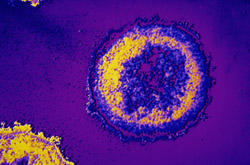
Bimolecular structures and interactions within single organelles (cytoplasmic structures surrounded by a membrane) are being studied using a number of technologies. These include UV and time-resolved resonance, surface enhanced Raman scattering spectroscopy and near infrared Fourier-transform. Such applications will provide information on fundamental bimolecular functions including the role that individual amino acids play. The use of complementary spectroscopic techniques with corresponding chemical and biochemical methods, mean that enzyme substrates along with drug/target interactions can be studied at the molecular and cellular level. Employing these technologies will make it possible to study the interior of cells. Information will be gathered on how cells are organised and how organelles interact. Applications of these novel spectroscopic methods include the investigation of anti-tumour activity, creation of agents to prevent tumour formation, production of inhibitors for HIV and the study of the receptors that regulate movement across cell walls.