Solar power harnesses biogas electricity

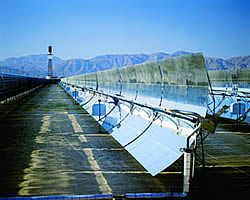
Dish/Stirling solar electric systems look like an array of satellite receiver dishes with a highly polished mirrored finish. Their potential is to create clean and sustainable energy supply, but currently the operational costs have proven to be uneconomical. As part of the drive to reduce costs from 11000 Euros/kWe to 5000Euros/kWe, a biogas combustion engine was developed to provide electricity in poor weather conditions. Each dish is designed to capture the suns energy and using point-focusing technology, convert the concentrated radiation up to the equivalent of 14000 suns/ 14000kW/m². The focal point of the dish then transfers the radiation to the receiver and the energy is transmitted to a heat transfer fluid such as air or helium. In turn, the gases that are created power the Stirling engines and the generators that are connected to them, providing the final output of electricity. As part of a project conducted under the Fifth Framework Programme, six 10kWe dishes were tested in Almeria, Spain for a total of 40000 hours leading to a reduction in costs of 6000Euros/kWe. The introduction of the Biogas Swirl combustion engine is set to reduce that cost even further, and at the same time provide a more stabilised level of electrical generation. Swirl combustion burners are able to operate on propane, natural gas and biogas; and it is the latter fuel source that should enable the BIODISH the profitability to be realised at last. The principle mechanics behind this operation is to sandwich a SiC ceramic receiver between the focal point of the dish, and the Swirl combustion engine. The Swirl combustion burner then produces a flame on to the reverse side of the receiver facilitating the transmission of energy to the heat transfer fluid. The concentration of radiation on the receiver can come from the solar focal point, the Swirl combustion burner or a combination of the two. Added advantages to the use of the Swirl combustion burner stem from the enhanced fuel and oxidising mixing that stabilises the flame, minimises pollutant emissions and maximises efficiency. In addition, and because the biogas harnesses agricultural waste matter as a natural source of energy, it will further benefit the environment with its economic disposal. Thus, irrespective of the environmental conditions and time of day/night, the BIODISH solar electric/Swirl combustion burner system can now produce profitable electricity - twenty-four/seven.