



Cutting-edge technology for assessing toxic waste

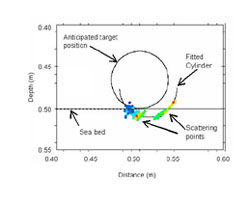
Management and risk assessment of toxic dumpsites has been a major issue due to the vast environmental and economic impact on marine life and human related activities. Emphasis has been given to advance oceanographic instrumentation and systems used to assess toxic waste within the bottom sediments in order to improve data reliability. In this framework SITAR researchers were successful in developing acoustic methods and instrumentation for imaging of small water containers buried in scattered sea sediments. In specific, multiple aspect scattering techniques were established to take high-frequency acoustic measurements in a multistatic set-up employing an innovative sonar system. A simulated model of European environments composed of medium-sized basin with real seabeds was used prior to sea trials to ensure experimental verification in controlled conditions. This is the first time that a complete dataset is collected at such frequencies using a variety of experimental conditions of target and seabed combinations. The information derived from this innovative sonar equipment enhances physical understanding of acoustic and remote sensing compared to conventional sonar. Specialized software techniques dedicated to this cutting-edge new technology have been developed. These involve deconvolution software for reconstruction of targets' position and scattering characteristics. The direct application to the physical aspects of seafloor mapping and acoustical oceanography is one of the assets of the new method. SITAR researchers envisage the dissemination of the results obtained to end-users and decision makers for further verification and prospective cooperation. The ultimate aim is the exploitation of the multiple-aspect scattering technique towards promoting military, environmental, geophysical or commercial interests. In addition the experimental methodology developed could be employed as a model for similar efforts in the field.