



Quality improvement interventions in healthcare

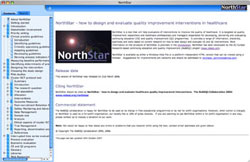
Since the establishment of the World Health Organisation, major new developments have occurred that have led governments and professionals to reconsider the methods they use to make decisions about healthcare. These changes have been driven by the recognition of gaps between available research findings and what is done in clinical practice. Traditional approaches rely heavily on the opinions of experts. However, systematic and transparent approaches to access and synthesise clinical evidence with other information and values are increasingly demanded. Northstar provides a range of information, checklists, examples and tools for the selection, implementation and evaluation of quality improvement interventions that would promote research evidence-based clinical practice. The target audience of the software tool includes quality improvement researchers and healthcare professionals responsible for developing and delivering continuing education and quality improvement programmes at regional and national level. Consequently, the software program was developed to be useful to users with varying levels of experience in quality improvement research and the text to be instructional as well as informative. With content building on the framework developed by the REBEQI project for selection and implementation of quality improvement interventions, it guides users on how to identify factors that affect practice patterns. Furthermore, it provides guidance on how to identify and select priorities in order to use resources efficiently. The major section of Northstar is dedicated to the development of protocols dedicated to the design of randomised, controlled trials for the evaluation of different quality improvement strategies. Northstar is available for download as either a Microsoft Windows Help file or a platform-independent HTML that can be viewed using a browser from the project website: http://www.rebeqi.org/(opens in new window)