Quantum measurements in ultracold atoms

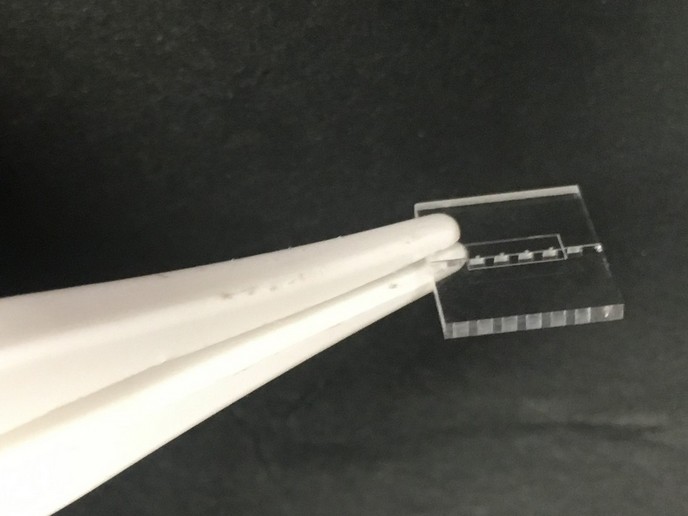
Atom chips are like tiny experimental toolboxes for studying the quantum world. Whereas a semi-conductor chip manipulates the electrons moving around inside it, an atom chip traps, manipulates and measures the atoms hovering a microscopic distance outside it in an ultra-high vacuum. Atoms trapped by such chips can be super-cooled to a region in which their position and velocity are controlled. These ultracold atoms, parts of ultracold gases, are being used in numerous experiments studying quantum information processing and quantum metrology, the use of quantum techniques to increase statistical precision of measurements. European researchers initiated the ‘Spatially resolved atom fluorescence imaging’ (SRAFI) project to apply a novel fluorescence imaging technique enabling visualisation of single atoms in the study of density fluctuations in Bose gases. Initial studies focused on successful implementation of the single atom detector based on detection of photons scattered by atoms as they cross a thin sheet of light in their trajectory path. Subsequently, the SRAFI team used the detection method to study degenerate quasi one-dimensional (1D) Bose gases. Degeneracy in Bose gases (gases made of bosons that form a new state of matter, Bose-Einstein condensates, when cooled to very low temperatures) is related to a disappearance of the correlation normally seen between the likely location of a specific particle in the gas with respect to the location of another particle. In other words, the positions become uncorrelated. Scientists studied both density fluctuations during time of flight as cold atoms of 1D Bose gases were released from the atom chip as well as collision relaxation processes, the latter providing insight into energy and momenta in quantum optics. Finally, the team accurately measured the coupling energy of so-called 1D bosonic Josephson junctions for ultracold gases which is conventionally quite difficult to measure experimentally. SRAFI project results contribute to the quantum understanding of matter with possible future applications in quantum information processing.