Earth structures provide firmer foundations

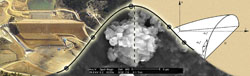
Unsaturated soils are relevant to geotechnical engineers worldwide as well as professionals concerned with a structure's interaction with the ground. Use of unsaturated soils in engineering includes incorporation in infrastructure embankments, nuclear waste repositories and flood defences. Pores in unsaturated soils are filled partly with water and air. Unsaturated soil mechanics have advanced under pressure from the construction industry to improve techniques for management and appraisal of the behaviour of earth structures. Crucial to ensuring long-term serviceability and cost effectiveness in compacted soils is an understanding of pre-failure behaviour. The 'Small to large deformations of unsaturated soils: an application to earth structures' (Sladus) project aimed to investigate the response of compacted soils to small strains for application in engineering dynamics. Data in this area can also be used in the analysis of earth structures under static loads such as pavements. Field trials were conducted at Mandova in Italy where a clayey silt embankment was erected for research purposes next to the flood defences of the River Po. Loose soil was collected for determination of basic soil properties as well as undisturbed soil samples by core drilling with a Shelby sampler. Sladus researchers performed four different series of laboratory tests on the undisturbed soil including two series of resonant column torsional shear tests to evaluate the shear elastic modulus and damping properties of soils. Triaxial Cell tests gave data on strength behaviour over a range of isotropic compression levels and shearing to critical state. Oedometric tests measured water retention curves at different stress levels. Loose soil from the embankment was used to determine other properties such as Atterberg limits, specific gravity and organic content. Depending on the water content, Atterberg limits measure the behaviour of the fine-grained soil (clayey silt in this case). Comparison of the data with other previous samples through state-of-the-art constitutive modelling helped to build up a repertoire of important differences in critical strength and small strain shear stiffness. With help from the University of Cassino, analysis of the microstructure of the sample with a scanning electron microscope aided the interpretation of results. Structural failure of roads and airfields and the damage caused by foundation settlement can often be traced back to the failure to achieve proper soil compaction. The work of Sladus will help to prevent destabilisation and to predict compacted soil behaviour during ground motion due to events such as earthquakes and the existence of high-speed railways.