Low-cost mass production technique for nanotech


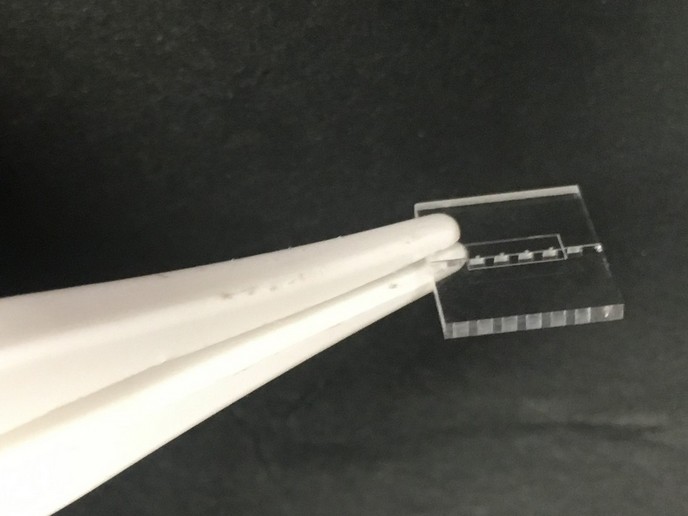
Nanotechnology, or the development of functional ‘machines’ on the scale of individual atoms and molecules, has made tremendous advances in numerous fields including electronics and materials science. One of the main obstacles to commercialisation of nanotechnology concepts and designs has been difficulty in scaling-up production for mass manufacture. Small and medium-sized enterprises (SMEs), of which many are working in the field of nanotechnology, are at a particular disadvantage with regards to investing in currently expensive equipment for nanofabrication. Nanoimprint lithography (NIL) is a method of creating an atomic-scale pattern on a polymer substrate using a stamp. In contrast to deep-ultraviolet and extreme-ultraviolet lithography (DUVL and EUVL, respectively) that rely on highly focused light to carve patterns in wafers, NIL uses simple mechanical deformation. It is characterised by significantly lower cost than DUVL and EUVL, high-throughput and good resolution, making it particularly attractive for SMEs. A consortium of European researchers set out to develop NIL for ultra-high precision manufacture of three-dimensional (3D) nanostructures with funding of the ‘Nanoimprint lithography for novel 2- and 3- dimensional nanostructures’ (3Dnanoprint) project. Scientists chose to test concepts using fabrication of 3D photonic crystals, historically very difficult to produce and thus an excellent indicator of project success. Photonic crystals are periodically arranged optical nanostructures important in manipulating light (electromagnetic radiation) in such applications as reflective coatings of lenses and mirrors. They must have periodicity or regular repeats in structure, at intervals on the scale of nanometres corresponding to the wavelengths of light to be manipulated. Thus, precision is a major challenge. Scientists built up the photonic crystal in the so-called ‘woodpile structure’. Each successive layer is ‘piled onto’ the previous with stringent alignment requirements to produce the desired periodicity without scattering and blurring. Significant progress was made in improving layer-to-layer alignment accuracy, enhancing NIL polymer substrates (resists) and improving the etching process. 3Dnanoprint concepts should help open the door to widespread, cost-effective nanofabrication by SMEs and thus an explosion of commercially available nanotechnology-based structures and devices waiting for mass production technology.