



Modelling volcanic eruptions for better risk assessment

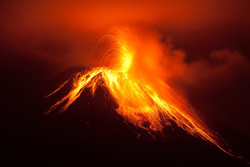
Volcanic eruptions can be slow (effusive), forming lava flows and domes, or very explosive, spewing high columns of ash often accompanied by gas and fragmented rock. The type of eruption is largely governed by the rate of magma ascent (magma being the molten rock beneath the Earth's surface). In order to investigate and elucidate how conduit geometries and processes control magma ascent, scientists initiated the EU-funded project 'magma ascent mathematical modelling and analysis' (MAMMA). Team members developed novel techniques and numerical codes to describe the fully coupled magma–gas flows and the changes in rheology accompanying degassing-induced crystallisation. Improved models of both effusive and explosive eruptions incorporated the complex relationships in multiphase flows. These models accounted for multiple flow phases ranging from homogenous magma to gas–particle dispersion during degassing, crystallisation and magma ascent. Laboratory experiments and field trips enabled data collection for testing the modelling framework and numerical results. The fast and scalable models of multi-physics coupled systems related to magma ascent and volcanic eruptions will have important impact on predicting volcanic activity. Modelling could reveal key variables that must be monitored in order to fully characterise a volcano system's state. The strong collaborations developed within MAMMA have provided a mutually beneficial partnership between the EU and the United States for volcano research and risk assessment.


