


In Europe’s forests, profitable timber is still key

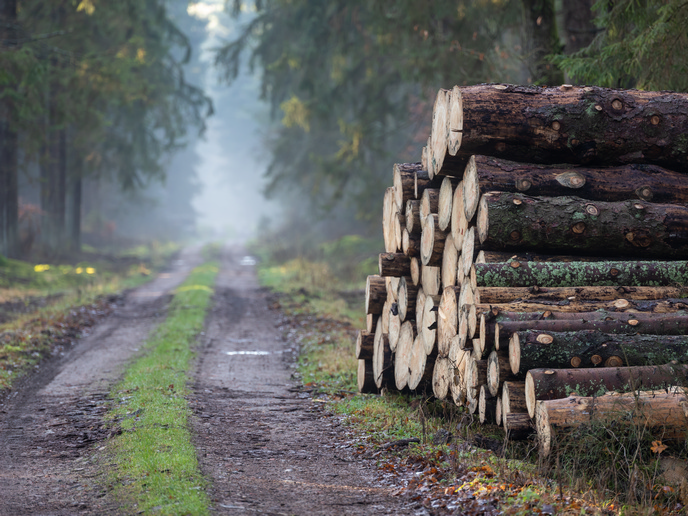
Have the European Green Deal and other EU policy instruments managed to shift the focus away from provisioning services that forests provide – and towards their regulating and cultural services? Not so, according to a new study(opens in new window) supported by the EU-funded SINCERE(opens in new window), InnoForESt(opens in new window) and INTERCEDE(opens in new window) projects. They found that forests in the EU remain primarily managed for wood production – the most profitable forest ecosystem service by far. For more than a century, forestry across Europe has mainly centred on the sustainable production of timber for building, followed by other provisioning services such as firewood, nuts, fruits and medicinal plants. While the less lucrative regulating services (e.g. carbon sequestration) and cultural services (e.g. ecotourism, recreation) have recently gained more public attention, it does not change the fact that about 47 % of Europe’s forests are privately owned and managed for profit. Add to that that even public forests are at least partially managed by profit-oriented companies, and it becomes clear that the income-generating potential of different ecosystem services plays a major role in how these forests are managed.
The link between profits and services
To find out how forest income is linked to the supply of different forest ecosystem services across Europe, the researchers began by conducting a pan-European survey of forest owners and managers on their sources of forest income. They then combined this information with forest characteristics, such as tree species composition, protection status and distance to nearest city. Lastly, they applied machine learning to extrapolate the survey results to the whole of Europe. The results show that about 80 % of European forest income is currently made through provisioning services. In contrast, regulating and cultural services are rarely seen as profitable. This highlights a clear mismatch between society’s demand for such services and current levels of forest income linked to these services. The research team identified two distinct clusters of European forest owners and managers. The first cluster manages mostly conifer-dominated forests in thinly populated areas of northern and eastern Europe, and derives nearly all its forest income from wood production. The second manages forests with broadleaved species mainly found in southern and western Europe, close to cities and designated as Natura 2000 sites. In this second cluster, regulating and cultural ecosystem services generate about one third of forest income, but at low profitability. The findings of this study supported by the SINCERE (Spurring INnovations for Forest ECosystem SERvices in Europe), InnoForESt (Smart information, governance and business innovations for sustainable supply and payment mechanisms for forest ecosystem services), and INTERCEDE (InceNtivising fuTurE foRest eCosystem sErvices anD incomes in Europe) projects stress the need for policies that do not only incentivise wood production but other ecosystem services as well. The study authors conclude “that recognizing both this spatial divide across Europe and the gap between forest owners’ economic incentives to provide preliminary provisioning ecosystem services, and societal demand emphasising regulating and cultural ecosystem services, is key for designing customized, effective policies for multiple forest ecosystem services.” For more information, please see: SINCERE project website(opens in new window) InnoForESt project website(opens in new window) INTERCEDE project website(opens in new window)

