


Östros outlines Research Council agenda
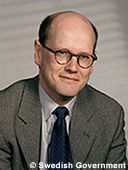
The recruitment of more young people to the sciences and research and improving the relationship between science and society will both be on the agenda at the Research Council meeting on 1 to 3 March, according to Thomas Östros, Swedish Minister for Education and Science and current Chairman of the Research Council of Ministers. Minister Östros gave an indication of the Research Council agenda whilst speaking at a symposium on 'Europe with a Human Face', held in Uppsala, Sweden on 26 February. 'How to attract more young people into obtaining a postgraduate education, how to encourage more students to seek research careers and how to transform Europe into a more attractive labour market for researchers in the international arena are central issues in most scientific fields,' said Mr Östros. 'In my opinion, we have to pay more attention to post-doctoral education, a level that the European countries have largely ignored for a long time,' he continued. Referring to the relationship between science and society, the Minister continued: 'What we need to do is both increase interest in, and knowledge about, research in society as a whole and to get researchers and decision-makers to listen to, and be more keenly aware of, the kinds of questions, and often even the disquiet, expressed by ordinary citizens.' Mentioning the European Commission's proposal for the next Framework programme as unveiled by Research Commissioner Philippe Busquin on 21 February, Minister Östros outlined three areas of priority for the Swedish Presidency in future European research policy. First, 'the Swedish Presidency considers it very important that a 'European Research Area' be created through cooperation and networking on a voluntary basis around freely chosen objectives,' Mr Östros began. Decisions concerning how to fund research should be made on the basis of scientific excellence and the quality of research, the Minister continued, and finally, 'we consider it essential that the great importance of the social sciences and the humanities be reflected in the new Framework programme,' he concluded. Mr Östros was careful to outline the importance of the social sciences. 'In my opinion, the contributions by social scientists and scholars in the humanities are most important in our efforts to secure a vital economy, strengthen democracy and human rights, increase our understanding of the human being and the world around him/her, and improve the quality of life and the welfare of everyone in a global knowledge-based society.' The social sciences should not be eclipsed by the physical sciences, said Mr Östros: 'The rapid developments in such sciences as biotechnology do not reduce the need for social sciences and humanities. On the contrary, social sciences and humanities become even more important to an understanding of man's situation in a modern society characterised by fast technological improvements, globalisation and new cultural patterns.' Minister Östros drew attention to Sweden's substantial investment in research - higher than any other EU Member State at almost 4 per cent - and stressed the Swedish belief that a strong role for the state contributes to successful results. 'We believe that basic research contributes to new knowledge as well as many important innovations, and that guaranteeing the freedom of research is a specific responsibility of the state,' he said.
Countries
Sweden