


EU and US commit to energy research collaboration
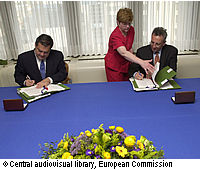
The first legally binding agreement between the EU and the USA since 1998's EU-US Cooperation Agreement, an agreement committing both parties to cooperation in energy research, was signed by Research Commissioner Philippe Busquin and US Secretary of State for Energy, Spencer Abraham in Brussels on 14 May. Two agreements were signed, one relating to research and development in fusion energy, and the other to non nuclear energy. The aim is to facilitate collaboration in research areas of mutual interest such as fossil energies, climate change, new energy sources, such as hydrogen and solar energy, and energy efficiency. 'The two agreements that we will sign today are aimed at the development of cooperation between the European Union and the United States. This could be structured around targeted exchanges, innovation analyses and paradigmatic changes either side of the Atlantic, mutual consultations and participation. It should contribute to the promotion of excellence, facilitate the emergence of innovative technologies, such as the use of hydrogen [...] and biomass, which could profoundly modify the worldwide view of energy.' In the framework of the agreement, new initiatives could be launched in the domain of fuel and hydrogen cells, socio-economic studies to aid decision making on the subject of energy and multidisciplinary research for the promotion of renewable energy. It is agreed in the document that scientists from both sides of the Atlantic may participate in each others' research programmes and studies, projects and experiments will be executed jointly. This will include activities in partnership with private industry and non governmental organisations selected through calls for proposals. A steering group will also be created in order to supervise the execution of the implementing arrangement. The group shall consist of technical coordinators for each technical field, appointed by lead coordinators from each 'side'. For the European Commission, DG Research, DG Energy and Transport and the Joint Research Centre (JRC) shall each designate a lead coordinator. Both Commissioner Busquin and State Secretary Abraham were keen to point out that the agreement will be a mutually beneficial one. 'We will buttress each others' efforts,' said Mr Abraham. Mr Busquin stated that he envisaged the exchange of researchers and emphasised that the arrangement will not result in a European brain drain. 'We want to strengthen mobility to the rest of the world, but also within the EU,' said Mr Busquin. 'We want to attract scientists to Europe, to make it as attractive as the US, which I think will be advantageous for everyone.' Whilst some might question the reasoning behind this new commitment to further research on clean energy so soon after the US rejection of the Kyoto protocol, Mr Abraham offered assurance that the United States is very committed to making the plan a balanced one. He highlighted the substantial investment that the US government has committed to geothermal and wind energy, and stressed that such investment will continue. He added that President Bush's announcement concerning the reassessment of the country's environmental policy was merely a 'statement of reality', a 'reflection of reality of the American political process', and announced that a series of recommendations on the subject is currently being put together and will be presented soon.