


Eureka reinforces backing for innovative SMEs
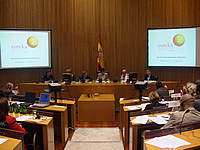
High ranking officials of the Spanish government were keen to lend their support to the Eureka inter-Parliamentary conference in Madrid on 17 and 18 May. Officials from the Spanish Parliamentary committee of science and technology were joined by Spanish science and technology minister Anna Birulés and the second deputy Prime Minister Mr Rodrigo Rato to welcome more than a hundred Parliamentarians from the 29 countries and representatives from the European Commission that make up Eureka's members. Coming towards the end of Spain's one-year chairmanship of Eureka - a high level network dedicated to promoting linkages and growth in European industrial research and development (R&D) and innovation - the conference aimed to take a reflexive look at the organisation's achievements and plans for the future when Spain hands the baton to Greece this June. The delegation was generally welcoming of Spain's efforts to adapt and improve in response to challenges both within and outside the network over the past year. Spain outlined four main objectives when it took over the chair of Eureka in 2000: opening Eureka to new scenarios; technological innovation for the service sector; support for fast growth enterprises; and to maintain continuous improvement of Eureka management. The Spanish are comfortable with the results. An increase in the number of projects generated and endorsed are testimony to its success, they say. 'Eureka is a flexible programme which provides tools to bring technology to market [and] Spanish participation in Eureka has been especially good...[we're] sitting on 22.3 per cent of the total number of Eureka projects,' said Xavier Trías, chairman of the committee of science and technology of the congress of deputies. Anna Birulés, the Spanish Minister for science and technology , was also proud of the Spanish participation which brings the number of Eureka label projects coordinated by Spanish companies up to the same level as France. 'We have worked hard on European projects in the services sector...we're talking about our citizens as customers for our technology,' she said. Participants were particularly pleased with Eureka's active involvement in discussions on the European Research Area (ERA), which they described as the most important initiative existing nowadays in the field of R&D. 'This is an important time,' Anna Birulés told the delegation. 'We are in a position to ensure that Eureka is complementary to the [European Commission's Sixth] framework project.' While the Commission's research framework programmes are very much based on a 'top-down' approach to funding, she said, Eureka aims for a bottom-up approach. 'Flexibility and bottom up project management are at the basis for very positive results. We have to have a very clear idea of decisive support for all the member countries to ensure that Eureka networks will grow stronger and bring results.' Under the Spanish chairmanship a joint working group including high level representatives from the European Commission, the Eureka secretariat and the Spanish chairmanship has met three times already this year to discuss future collaboration. Together they have identified two priority areas for action: integrated projects within strategic technological fields and reinforcement of the innovative performance of small and medium sized enterprises (SMEs), 'Both strategies could contribute to reduce the gap between Europe and the USA in terms of R&D,' reports the Spanish chair. Currently, some 30 per cent of Eureka projects include companies and organisations form the service sector Eureka also wants to strengthen support for SMEs approaching venture capitalists (VC) for private funding. They looked at the difficulties faced by R&D SMEs when trying to attract VC and see this as a fundamental challenge for the future. Looking at an expert advisory group's analysis of the relationship between the private funding of R&D, especially in the context of VC and Eureka enterprises, they said specific recommendation should be proposed to diffuse information and for promotional actions. The Eureka network could play an important role in making Eureka-backed SMEs visible for private investors and for informing SMEs themselves about funding opportunities. To achieve this the Spanish chair has set up the 'Lynx award' scheme to recognise the best performance in growth among SMEs participating in the Eureka projects. Parliamentarians at the Madrid conference were strongly supportive of this initiative and resolved to lobby for a number of actions that will further strengthen support for small and medium sized enterprises at Eureka's June Ministerial conference. They will call for an increase in national funding for Eureka projects, speeding up of national funding decisions, raising Eureka's profile and therefore priority at a political level, and for assurance that Eureka is regarded as an integral part of ERA. The Madrid conference also recognised the importance of having participants from the Central and Eastern European countries and recommended that special efforts should be made in order to develop their integration with activities of strategic importance Europe, with particular emphasis on the environment sector. In this context, participants welcomed Estonia and Slovakia's applications to join Eureka after receiving a positive assessment from the network. Both will be presented at the forthcoming Eureka Ministerial conference in June. Greece will formally take over the chairmanship of Eureka for the next year at the Ministerial conference in Madrid in June. Ionnis Papadakis from the Technological development directorate of the Greek Eureka office, explained how his country aims to maintain continuity of the initiatives launched by Spain and previous chairs. Greece also plans to propose a number of its own initiatives based on four main issues, he said. These are: - strengthening Europe by improving its attractiveness, increasing visibility and demonstrating its flexibility.' We'd like to develop a clear understanding of the benefits of Eureka,' said Papadakis, indicating that this should include enhancement of cooperation in the Sixth Framework programme and ERA. 'We must have better coordination of national funding,' he said, echoing the sentiments expressed by Research Commissioner Philippe Busquin in the Commission's proposal for an ERA. In particular, the Greeks want to give a fresh impetus to the new knowledge economy and the service sector '... and we will explore how to assist SME start ups,' he said. One such method could be through improving cooperation with innovation relay centres for the dissemination of information, he suggested. - generation of innovative projects looking at how to reinforce marketing to attract new funding. Here, Greece wants to emphasise four sectors: information and communication technologies, environmental technology, tourism and cultural heritage; and advanced manufacturing and applications for SMEs. - reinforcement of Europe to world wide cooperation; - sustainable Eureka management. 'Although Eureka is decentralised the network comprises many different cultures and approaches. Management is very important,' said Papadakis. 'Eureka has come far in the past few years...I think we have reached a very good momentum. The timing is very good...Eureka is market driven and always has been. In our day, this is very important. Our society today needs sometimes to be urged. We have to keep promoting solutions that the new economy can offer,' he concluded.
Countries
Greece