


European Observatory identifies record-breaking asteroid
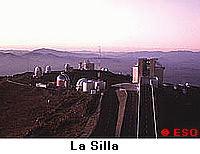
European researchers at the European Southern Observatory (ESO) have identified an asteroid larger than any other known object of its kind in the solar system. A team of German, Finnish and Swedish astronomers used a conventional telescope at the European Southern Observatory in La Silla, Chile in combination with Astrovirtel, the world's first operational virtual telescope based at ESO headquarters in Garching, Germany, to gain a more accurate measurement of the size of distant asteroid '2001 KX76.' The team found that the newly-discovered asteroid, with a diameter of between 1200 and 1400 km, is significantly larger than previous record holder Ceres. This 950-km wide asteroid, the first object of its type to be discovered, was observed by Italian astronomer Giuseppe Piazzi in 1801. The astronomers reached their conclusion using data from the Astrovirtel virtual telescope, an advanced prototype tool which mimics a telescope to provide a variety of high-quality data. Using information from Astrovirtel in conjunction with conventional telescope data, the European team was able to generate a more accurate computation of the size and probable orbit of asteroid 2001 KX76. They found that the asteroid is near to the Planet Pluto and follows a roughly similar orbit. Astrovirtel co-ordinator Piero Benvenuti said: 'These results are thrilling for more than one reason. The latest in modern astronomical technology combined with a novel scientific procedure has been able to produce results that would otherwise have been difficult to achieve. I am very delighted to see the first important scientific results materialise from our work with Astrovirtel.' The Astrovirtel telescope, which has been in operation for roughly a year, is a prototype for the concept of web-based 'virtual observatories.' A larger study, the Astrophysical Virtual Observatory', is about to get under way as part of the EU's Fifth RTD Framework programme. The project will involve collaboration between ESO, the European Space Agency, the University of Edinburgh, UK, CDS in Strasbourg, France, CNRS in Paris, France and the University of Manchester, UK.