


Ministers back eEurope 2005 action plan at informal meeting
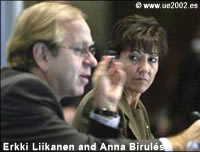
A new eEurope 2003 to 2005 action plan was given unanimous backing at an informal meeting of EU Ministers for telecommunications and the information society in Vitoria, Spain, from 21 to 23 February. A request will now be made to heads of state at the Barcelona summit in March to confirm the programme's prolongation and to give more impetus to information society policies. The ministers agreed that although the eEurope 2002 action plan has led to some important achievements, much remains to be done to meet the objective set out at the Lisbon European Council in March 2000 of making Europe the world's most competitive knowledge-based society. The Ministers discussed plans for a new eEurope 2005 action plan to supersede eEurope 2002 and provide fresh impetus to the drive towards an information society. 'This plan is fundamental to increase social welfare, wealth and employment in the European context,' said Spanish Minister for science and technology, Ana Birulés. The ministerial discussions highlighted the need for enhanced cooperation between governments and the private sector in the design and implementation of the new action plan. They called on both Member States and the European Commission to make arrangements for the monitoring of national and European regulatory initiatives that impact on e-commerce, and identify factors that prevent enterprises maximising the potential of information and communication technologies (ICT) for their business. Ministers also called on the Union to step up efforts to build on technological convergence in areas such as digital television and third generation (3G) mobile communications. Ministers highlighted that the measures drawn up in the ministerial declaration which followed the eGovernment conference in November 2001 should be followed up to enable governments and European institutions to take the lead in providing online public services. Other priorities outlined at the informal meeting include moves to promote e-business and e-learning and to ensure that digital content is available in users' native language. Member States and the private sector are also encouraged to make broadband a priority. Ms Birulés said that the initiative with this needed to be with the private sector, but in the case of market failures, public funds could also be expected, within the context of the usual rules. The public sector in particular is called upon to set an example for the development of broadband Internet services by promoting their use in disfavoured regions, in government and in health and education services. Ministers also called for moves to ensure that the elderly and those with disabilities have access to electronic services such as e-government and e-health. In addition, the Ministers called for better pan-European cooperation in the area of network security and safe access to e-government and e-business. They called for rapid implementation of the Council resolution of 15 January 2002 on network and information security, which proposes a number of measures to increase awareness of security, establish a cyber-security task force and foster national Computer emergency response teams (CERTs). They also highlighted the need for the widespread use of electronic signatures. The ministers agreed that candidate countries could also benefit from the exchange of best practices brought about by the eEurope 2005 action plan, and called for moves to strengthen European leadership in the information society by including an international dimension in the extended action plan. They drew particular attention to the need for an international outlook in the context of the two-phase World Summit on the Information Society which is due to take place in Geneva in December 2003 and Tunisia in 2005.
Countries
Spain