


Busquin hails EIROforum as 'the best network of excellence under FP6'
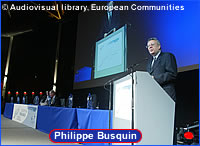
EIROforum, a collaborative group made up of representatives from Europe's leading intergovernmental research organisations, was formally established on 12 November at a signing ceremony attended by Research Commissioner Philippe Busquin. The Director Generals of CERN (nuclear research), EMBL (molecular biology), ESA (space), ESO, (astronomy), ESRF (synchrotron radiation), ILL (neutron source) and EFDA (fusion) signed the EIROforum Charter to seal their partnership at the Sixth Framework Programme (FP6) launch conference in Brussels on 12 November. Mr Busquin welcomed the partnership by saying: 'The establishment of EIROforum is a concrete example of the dynamic created by the European Research Area. Europe has unquestioned excellence in science. By working together, Europe's leading research organisations can make that more visible on the European and world stage.' Dr Antonio Rodotà, representing the European Space Agency, said that the partnership was important on two levels. In terms of substance, he said, the collaboration reflects 'the interdisciplinary nature of modern science, and the many shared interests of the organisations involved.' Symbolically, he said, the agreement sends out the message that 'European research won't be divided - these organisations will work together for the betterment of society.' The first EIROforum joint initiatives have focussed on outreach and education activities involving science teachers and students from across Europe, raising interest in science and technology in an attempt to secure the next generation of researchers. Future activities will focus on human resources, EU policy consultation, external relations, GRID technologies and results dissemination. The partner organisations of EIROforum are in direct contact with tens of thousands of Europe's scientists, and provide key infrastructures and services to their members. They also conduct training activities, and are often focal points for public interest in science. Dr Rodotà was keen to stress that the partnership was 'not simply a collaboration of seven organisations, but the wider scientific communities that they represent.' With the added value that their association will deliver, he hopes that 'one plus one will equal three, not two!'