


Greek Presidency reiterates its commitment to boosting Europe's competitiveness
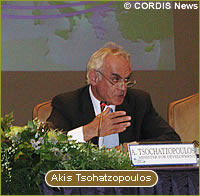
Greek ministers have marked the beginning of Greece's six-month Presidency of the EU by reaffirming their commitment to achieving the Lisbon goals on economic competitiveness. Greece took over the leadership of the European Council from Denmark on 1 January 2003, the fourth time it has done so since becoming part of the European Community in 1981. In a message to mark the start of the new Presidency, Greek Foreign Minister George Papandreou said: 'We want a European Union with a strong and competitive economy; a European Union that exploits the new technologies and the information society with a view to fuelling employment and economic development, in the interest of European citizens.' In a separate statement, written to welcome users to the CORDIS Greek Presidency service, Akis Tsohatzopoulos, Greek Minister of Development, outlines in detail the challenges facing Europe's bid to become the world's most competitive economy by 2010, and urged the research community to make the most of the opportunities offered by the Sixth Framework Programme. The Minister warns, however, that 'the adoption and execution of the Sixth Framework Programme is only one, amongst many actions that will help us to reach the goals set out in Lisbon,' and described the challenges still facing Europe as 'formidable'. A key challenge, according to Mr Tsohatzopoulos, is achieving an increase in levels of research spending to three per cent of GDP, two thirds of which must come from the private sector. 'This is a target to be addressed with a lot of care, involving issues that transcend research as such and address the motivation of businesses to invest,' he said. Another objective during the Greek Presidency will be the definition and adoption of a cheap and effective patenting system for Europe, a fundamental element in the innovation process according to the Minister. Finally, Mr Tsohatzopoulos asserts that laboratory-based research alone does not hold the key to Europe's competitiveness, and that 'it has to be coupled with the appropriate environment for innovation'. Among the measures needed for creating such an environment, the Minister highlighted organisational improvements and integration, increased investment in human capital, the opening of research infrastructures to all European scientists, and encouraging the mobility of researchers. In conclusion Mr Tsohatzopoulos confirms the Greek Presidency's commitment to achieving the Lisbon goal. 'This is a hard task and, even if we have not narrowed the gap with other regions yet, we set and are still setting out the conditions to do so. We need to reconfirm our goal and work towards it with all our strength,' he said.
Countries
Greece