


Seminar reveals Finnish approach and progress in building ERA
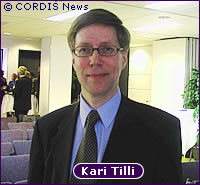
Finland is a model of which other Member States should take note, concluded a seminar on the Finnish approach to building a European Research Area (ERA) in information communication technologies (ICT) on 9 April. Speaking at the event, Kari Tilli, Director of TEKES, the national technology agency, said that the ERA objective of developing a shared vision of research and technology is already affecting national thinking and perspectives in Finland. In fact strengthening cooperation between national and other European activities has been incorporated in the new Finnish research and development programmes run by TEKES and the Academy of Finland. 'TEKES is not working in isolation. Instead it is using resources outside its boundaries, most notably Commission studies, and looking at how to implement them into a national context,' said Dr Tilli, in an interview with CORDIS News. However, while Finland has a good track record in fostering international relations in the fields of research and technology, Dr Tilli argued that there are many challenges facing cooperation and networking between national programmes. In particular, he noted that although there is a well developed culture of networking at research project level, developing this type of cooperation at national programme level proves to be a much more difficult task. '[It] is extremely hard work to get a real understanding of the national programmes of other Member States,' said Dr Tilli, adding that a social system similar to that found at a local level is needed. Indeed part of Finland's success in ICT and other research and technology fields has been the networking between companies and universities at local and national levels. 'We are very much pushing this in the Finnish context, but to have such networks at European level is extremely hard because it takes many years to get such results,' Dr Tilli told CORDIS News. Another stumbling block is the recognisable differences between national programmes throughout Europe. 'I think the most difficult part is to really be aware of other countries' activities and understand what they are thinking, what is the meaning of 'programme' in their countries, and to see who are the most beneficial partners for us.' However, despite such barriers, Dr Tilli believes that the objectives of national programmes are quite similar and the measures already carried out in Finland will be beneficial to the ERA's overall objective. Some of the steps taken in Finland towards better cooperation include the establishment of jointly funded and coordinated research programmes as well as the organisation of joint technology programme seminars, the benchmarking of national activities and the use of international evaluators. Dr Tilli also pointed to increased participation in the ERA-Net project as crucial in developing a transnational vision of RTD activities. 'We see it as being extremely useful and therefore our plan at the moment is to be active in this area.' Also speaking at the event was Wolfgang Wittke of the European Commission's Research DG, who agreed that ERA-Net is a stepping stone from well established networking at project level to an open method of coordination at policy level. 'The objective is to set up the cooperation and coordination of national or regional research activities through the networking of programmes which are strategically planned and nationally or regionally funded [...]. The benefits include increased cooperation with European colleagues, an exchange of best practices, identification of who is doing what and an exchange of programme management approaches,' said Dr Wittke. He also outlined activities already underway at EU level that are increasing transnational understanding and cooperation. In particular, tools such as an information society technology (IST) ERA portal and a coordination framework that maps potential synergies will provide a coherent approach to structuring information so that comparisons can be made, said Dr Wittke. Dr Wittke concluded by saying that the Finnish approach to promoting international cooperation in research and technology activities will enable Finland to full benefit from the Sixth Framework Programme, ERA and ERA-Net.
Countries
Finland