


ESA calls on Convention not to overlook 30 years of achievements
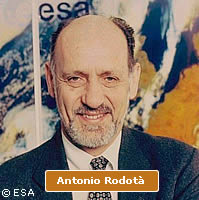
Antonio Rodotà, Director General of the European Space Agency (ESA), is using his final days as the head of the agency to outline his vision of Europe's future in space. This future involves the recognition by policy makers of ESA's competence and achievements and makes the most of these for the benefit of Europe. Mr Rodotà took up the position of ESA Director General in 1997, and after six years, will hand over to Jean-Jacques Dordain on 30 June. It was under Mr Rodotà's leadership that the Galileo project (Europe's first satellite navigation system) was conceived, following a meeting with the EU's then Transport Commissioner, Neil Kinnock. Galileo is the first concrete example of cooperation between the EU and ESA, and while both parties wish to reinforce this cooperation, a framework agreement outlining such a partnership has yet to be reached. Mr Rodotà's main concern is that ESA's 30 years of achievement will be overlooked, a worry fuelled by the recently published draft of the European constitution, agreed by the Convention. The document alludes to the development of competences in space at European level, but does not mention ESA. 'There is already a treaty [the ESA treaty] that awards responsibility in space. If another treaty is awarding the same responsibility to another body we have a problem,' said Mr Rodotà on 16 June. 'If we don't take care of the agency and what has been done, we risk real damage to Europe.' European space stakeholders have already been disappointed by the removal of space from Article 3 of the constitution, where the exploration of space was originally outlined as one of the aims of the EU. The Commission's Research DG is still hoping that space will be awarded the status of shared competence, and ESA is hoping that the constitution will be rejected by the Heads of State and Government on account of its disregard for ESA. 'We hope governments will bear in mind what they have already achieved through ESA,' said Jean-Pol Poncelet, ESA's director of strategy and external relations, and the former Defence Minister of Belgium. 'The constitution gives the feeling that they are suddenly discovering space - that space starts today,' said Mr Poncelet. 'It should at least recognise that the last 30 years have passed and that achievements were made,' he added. Both the EU and ESA have much to gain from a closer partnership. 'We understand we don't have the political view of general needs,' said Mr Rodotà. He concedes that ESA would win political leverage from partnership with the EU, which would not be possible through the agency's current intergovernmental structure, but at the same time, the EU could 'increase efficiency and bring the benefit to the citizens. [...] We have to begin with a dual recognition of competences.' Claudio Mastracci, ESA's director of applications, referred to the discussion on the relationship between ESA and the EU as a 'philosophical debate that must be driven by juridical issues.' The main sticking point is the different rules of participation. ESA members pay a fixed amount and then contribute more according to which programmes they would like to participate in. Investment is rewarded in the form of contracts in line with the concept of 'juste retour'. The EU works under different rules, where contributions depend on a country's GDP. 'These sorts of technical difficulties should be solved and there is a common interest in doing this,' said Mr Mastracci. The most important issue is that space is seen at European level and not at national level, said Mr Mastracci. He highlighted the importance of ESA maintaining its strategic role at European level, but emphasised that this role should not conflict with the European Commission's role. Mr Rodotà also emphasised what ESA has to offer the EU in terms of turning technology into commercially viable applications: 'We don't want to just share competence, but to help the Commission with applications,' said Mr Rodotà. This was a point echoed by ESA's director of technical and operational support, Gaele Winters. Mr Winters believes that space should not be tied to research, as it is a political asset. The EU should 'place space at the appropriate level so it can be applied to all areas. Industry wants to use space and we are ready to give,' he said.