


Eureka recognises SMEs and environmental performance in annual awards
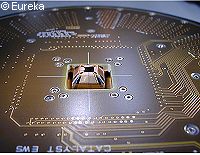
Eureka, the European network for industry focused research and development, has singled out two projects addressing atmospheric pollution and silicon wafer testing for its annual Lillehammer and Lynx awards. The prize winners were announced at the Eureka ministerial conference in Paris on 18 July, where the coordinators of the winning projects were each presented with their award and a cheque for 10,000 euro. The Lillehammer award has been presented annually since its conception under the Norwegian Eureka presidency in 1994, in recognition of a Eureka project that has delivered outstanding environmental benefits. This year's winner was EUROTRAC-2, a collaborative project involving over 300 researchers in 30 countries who undertook the largest ever study of atmospheric pollution in the EU. The primary objective of EUROTRAC-2 was to improve scientific understanding of the development, behaviour, transport and effects of atmospheric pollution in the lower atmosphere (troposphere) in order to provide improved recommendations on reduction and avoidance strategies to policy makers. This was achieved by carrying out 14 sub-projects to analyse the transport and chemical transformation of certain trace constituents in the troposphere. Among their findings was the discovery that tropospheric ozone, which is carried over long distances between continents, plays an important role in atmospheric pollution, and despite successful regional measures to reduce short-term peak concentrations in cities, average ozone levels have increased significantly. The researchers also revealed that ultra fine particles such as aerosols and nanoparticles play a similarly important role in air quality, and that concentrations of these substances regularly exceed EU limits. 'EUROTRAC-2 has significantly advanced scientific understanding of where pollutants are created, how they travel, and how they interact with human and environmental health. These are essential preconditions for effective environmental policy making,' said French Research Minister François d'Aubert, presenting the award. Indeed, the results of EUROTRAC-2 have contributed to the process of identifying a European consensus on environmental strategies, and were a significant factor in the decision to establish a pan-European research network on pollutants in the lower atmosphere, which includes partners from the new EU Member States. '[The project's] approach - a bottom-up structure overseen by respective committees - has created a new European dimension in atmospheric research,' said Dr Pauline Midgley from the German national researcher centre for environment and health who coordinated the project. In accepting the award, Dr Midgley thanked the scientists that worked on the project, as well as the German Federal Ministry of Education and Research, which funded the project's secretariat. She also revealed that the 10,000 euro prize would be put back into the EUROTRAC-2 research community through the creation of a one-off young scientist award to honour the best young researchers from the project. The second prize to be announced was the Lynx award, which recognises a high-tech small to medium sized enterprise (SME) where participation in a Eureka project has led to significant financial and commercial growth. First given in 2001, this year's award went to the French company Mesatronic, whose participation in the project NEWTECT led to the development of new testing technologies for miniature silicon wafers. The project consortium, which included partners from France, Switzerland and Italy, set out to develop new probe card technology that could accurately test the quality of high density silicon wafers. Due to the minute distances involved, however, rather than manufacturing the metal probes for the cards, they decided to use a new growth method called electroforming, something of a technological breakthrough. 'Our idea had great market potential, but we lacked funding and know-how,' said Mesatronic's CEO and managing director André Belmont. 'Eureka, with its unique industry-oriented approach, gave us this opportunity.' Mr Belmont said that his company found the Eureka process very simple and effective for SMEs, and that he would like to see the format extended. Having started out with a staff of two and an annual turnover of 100,000 euro in 1993, Mesatronic now employs 64 people and last year generated nine million euro worth of business. According to the company, around three million euro of that figure and 30 jobs are directly attributable to Mesatronic's participation in NEWTECT.
Countries
Germany