


Liikanen presents strategy for ensuring European dominance in intelligent embedded systems
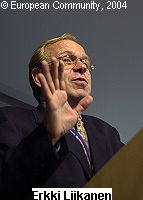
A public-private partnership will be set up before the end of 2004 with the aim of mobilising resources and drafting a strategy to ensure that Europe becomes the world leader in intelligent embedded systems. The partnership, involving representatives from 17 research and industry organisations, will take the form of a 'technology platform', and will be known as ARTEMIS (advanced R&D [research and development] on embedded intelligent systems). Its task will be to mobilise and coordinate the private and public resources needed to meet business, technical and structural challenges. EU Enterprise and Information Society Commissioner, Erkki Liikanen, gave an idea on 28 June of the enormous potential that embedded information and communication technologies (ICTs) have: 'Success in this domain will result in strengthening the competitiveness of European industry by increasing productivity, offering enhanced products, services and commodities. It can also improve safety, security and health conditions and create new specialised jobs.' The growth in embedded technologies has been huge. In 2003 there were around eight billion processors worldwide, and this figure is expected to double by 2010. In more comprehensible terms, this would mean three embedded devices per person worldwide. In the automotive industry, electronics are now accounting for an increased fraction of a vehicle's production costs - from 22 per cent in 1997 to between 33 and 40 per cent in 2010. Europe does already have a number of strengths, emphasised Mr Liikanen. This is particularly the case in the areas of consumer electronics and mobile communications, and also where safety and reliability are critical requirements in the control of large systems. Numerous sectors, including transport, medicine, the environment, energy and communications are increasingly embracing technical advances that ultimately contribute to improved quality of life. 'We need to remain strong' was the Commissioner's principal message at the high level meeting on the creation of a technology platform. And while a vision of the future is essential, Europe must also implement concrete measures in order to shore up its position, Mr Liikanen added: 'We need to have a clear perception of where future stakes will be played. These days, we are presented with many 'visions' of a future, enabled by the advent of these new technologies [...]. Europe has to be the first to go from visions of the future into new application domains, new services, and new opportunities, creating brand new markets of immense potential.' There is every chance that Europe could become world leader in embedded technologies. As highlighted by Mr Liikanen, this position is currently still vacant. The task for governments is to create a level playing field that stimulates competition in the new markets, claimed the Commissioner. Another challenge is to coordinate and focus research, and then to ensure that the results of this research are disseminated effectively. Mr Liikanen therefore charged ARTEMIS with fostering the creation of poles of excellence, acting as a catalyst for articulating research efforts, coordinating national and European programmes and developing standards and regulation where necessary. Finally, the Commissioner urged the members of ARTEMIS to think beyond short term gains. 'We again need the ambition to think and act beyond current product lines and short term agendas, to create a critical mass of research and investment and to ensure focus on common goals.' Mr Liikanen then concluded by asking the members of the technology platform to be ambitious.