


Students' winning robots get final outing in Brussels
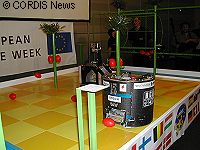
Some of the best robots built by European students aged between 17 and 25 were in the European Parliament in Brussels, Belgium, on 9 November as part of European Science Week. The robots took part in a demonstration event, while their designers received the prizes that they won earlier in the year at the Eurobot final. MEP and former EU Research Commissioner Philippe Busquin opened the event and paid tribute to both the Eurobot participants and those who initiated and implemented what he called 'an exemplary mission - a European idea'. Eurobot is a high level robotics competition that pits totally autonomous robots against each other in a predetermined sports challenge. In 2004, the robots competed at 'coconut rugby'. The aim of the game was to collect coconuts and get them into the opponent's goal, thus scoring a try, or to throw them between the opponent's coconut trees, thus scoring a drop goal. Team Sapaero from France was crowned 2004 champion, while Team ID from Switzerland took second place. The final in May followed eight national competitions (in Austria, Belgium, the Czech Republic, France, Germany, Serbia-Montenegro, Spain and Switzerland). Teams from countries outside Europe, including the US, Algeria and Iran were also invited to participate in the final. In total, 20 countries and over 3000 young people from universities, engineering schools and scientific clubs took part in 2004. This figure is expected to grow still further in 2005, with countries such as Greece, Bulgaria and Romania already having expressed an interest in participating. Emmanuel Tillaux, who coordinated the prizewinning Team Sapaero, explained to CORDIS News how the team, which comprised 20 members, had worked together over nine months on their robot. When the rules for 2004 were first announced, the team members had a brainstorming session and then selected the best and most practical ideas. Work was then divided between the various team members according to their area of expertise. The team was certainly dedicated, working on the project every day after school and at weekends for nine months. The team estimates that a total of 6,000 hours were devoted to the project. In the run up to the final in May, team members were even missing classes in order to be ready on time. Lecturers turned a blind eye, said Mr Tillaux! For most of the competing teams, the competition is classed as an extra-curricula activity, although it has been integrated into the teaching programme of some colleges and universities. As Team Sapaero's robot outmanoeuvred all the other finalists, the hard work paid off. But according to Mr Tillaux, the work was principally worthwhile because they succeeded in building the robot that they had hoped to build. Winning was a bonus and not the ultimate aim, he told CORDIS News. Team Sapaero and Mr Tillaux will be back next year, when the robots will compete at bowling. The concept of bowling has vexed the team somewhat, but they are currently at the stage of deciding which team members' ideas to pursue. The competition is widely viewed as a success, and received coverage on 15 television channels around Europe. This year the project received funding from the European Commission under the Science Week initiative (running from 8 to 14 November) on account of its ability to not only attract young scientists, but to communicate science to the general public. Mr Busquin said that communicating science to the public should be and is a primary occupation of the European Union. The activity is currently funded under the 'science and society' activity of the European Commission's Sixth Framework Programme (FP6), which Mr Busquin said he hopes will continue to be a priority under FP7.