


Winner of 2004 innovation prize just keeps on innovating!
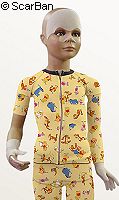
A small, family-run Belgian company, Tricolast NV, has made huge strides towards treating children with severe burns by securing a deal with Disney enabling them to print cartoon heroes on pressure garments for burns victims. Many parents struggle to get their children to wear a pressure garment- essential for the effective treatment of severe burns - for the required period of time. Having Winnie the Pooh and friends on the clothing is likely to change this, while the accompanying booklet in which Winnie, Tigger, Piglet and Eeyore explain the healing process will offer a form of psychological therapy to supplement the medical treatment. 'We approached Disney with a view to making pressure garments more appealing to children, who, particularly when young, are unable to appreciate the seriousness of wearing the garment at all times,' says Bernard Hoste, grandson of the company's founder and responsible for exports and business development. Considering that around 40 per cent of burns victims are aged five years and under, the new approach is likely to affect a high number of patients. Printing on pressure garments is not, however, as straightforward as one may think. The company's garments, distributed under the brand name of ScarBan, are of a very high quality, and are the result of detailed research into threads, microfibres and knitting techniques. It was important for the company that any aesthetic change to the garments would not impair quality. A printing method that does not affect elasticity needed to be found, and was found by Mr Hoste. 'Quality is first, and packaging second,' says company partner Dominiek Viaene. The pressure garment works by replacing the natural pressure that skin provides which is lost when the skin has come away. When skin is missing, the body will repair that area as quickly as possible. As soon as the wound has closed, pressure garments provide 'natural pressure', so that the skin can grow stronger instead of building up hypertrophic or keloid scars. If scars do start to form, a combination of silicon sheets or silicon garments can be combined with the pressure garments to reduce scarring. Each garment is made individually according to a very precise set of measurements received from the patient's orthopedic specialist. The storybook for children will contain the same information that the company's partners give to patients at medical centres, and will aim to offer some reassurance to young burns victims. The company works very closely with medical centres, and its executives are familiar with the sorts of questions that are often asked. The company's manager, Thérèse Hoste, is particularly familiar with patients concerns and needs. She still tries to spend one day every week in a burns centre. It is Ms Hoste who initiated the company's research into pressure garments in the early 1980s, and she is still eager to improve the available treatment still further. 'I see a burns patient and I see what the patient needs. I know what's on the market and want to do something better,' says Ms Hoste. 'I am born with a drive and I have to do it.' Both Ms Hoste's son and Mr Viaene recognise that it is her skill as a problem-solver that has made the company successful. That and the quality of its products. 'Big companies are usually not interested in solving individual or hyper technical problems,' believes Ms Hoste. It is this aspect of Tricolast that many medical experts have come to appreciate. Ms Hoste has built up a strong relationship with a number of top medical experts, and it is not at all unusual for them to ask for her help when a new case arrives. As Ms Hoste herself has no medical training, this esteem is something that she very much appreciates. Burns specialists are not the only people who recognise the innovativeness of Tricolast and its ScarBan products. In 2004, the company won the European Innovact Prize for innovation. Winning the prize gave the company a global image and a presence in the market, believe the partners. And this innovation is not restricted to the company's scar treatment products, but extends to production methods. Tricolast embraced automation in 2003, and has seen a tenfold increase in its capacity for producing pressure garments since then. Digitalisation has also enabled the company to process orders much faster, so that a garment can be provided four to seven days after an order is placed. The changes have paid off. While the company's turnover was just under 600,000 euro in 2002, it reached around one million euro in 2004. Turnover from exports over the same period also increased from around 11 per cent to 54 per cent. This figure is expected to rise still further in coming years. Tricolast has already found a good distributor for the Netherlands, and is now looking at opportunities in a number of other countries, including Germany, France, Switzerland, Austria, New Zealand, Australia and Singapore. The key to increasing exports is finding 'the right distributor with the same idea of quality and as close to the patient as possible,' says Mr Viaene. Tricolast is also planning to improve its range of ScarBan products still further. In addition to pressure garments, the company produces silicon garments and silicon sheets. Silicon is known to moisturise areas that may be problematic, such as joints, and thus to aid the healing process. As recently as 2000, silicon was known but not accepted by the medical community, according to Mr Hoste. It is now generally agreed that the combination of silicon and pressure is the optimal treatment for severe burns. 'We are going to keep investing in R&D. Everyone now accepts that silicon works, but nobody knows why, what it does precisely, and where,' says Mr Hoste. His mother also has many ideas for other silicon applications and is eager to investigate them. In burns centres in Belgium she is already known to some as 'Mrs Silicon'! Tricolast is committed to finding the optimal treatment for the treatment of burns; it is what Mr Viaene describes as one of the company's 'ethical ambitions'. Another is to disseminate this knowledge. 'We have no right to withhold knowledge and to see patients in other countries get less effective treatment than others,' he told CORDIS News.
Countries
Belgium