


Experts call for more EU action on infectious diseases
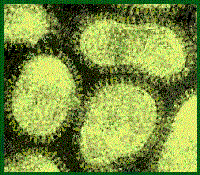
An international working group of experts has produced a report for the European Academies Science Advisory Council (EASAC) calling on the EU to give more priority and resources to the control of infectious diseases. The report aims to introduce the major issues facing policy makers with respect to infectious diseases, and to identify priorities for further work by EASAC. Volker ter Meulen, who chaired the working group that drafted the report, presented its findings to MEPs at a lunch briefing in the European Parliament on 14 June. First, Professor ter Meulen outlined the present global situation, citing World Health Organisation (WHO) statistics estimating that infectious diseases account for around one third of all deaths, compared with cancer, which accounts for just 12 per cent. The situation in the developing world is worse still, where almost half of all fatalities are due to infectious diseases. In Europe, the biggest threats are viral and bacterial diseases, the former group including influenza, coronaviruses such as SARS, and retroviruses such as HIV/AIDS, while the latter group covers tuberculosis and meningitis. Parasitic diseases such as malaria are more prevalent in developing countries than in industrialised parts of the world. Professor ter Meulen used the example of influenza to highlight the threat posed by infectious diseases. 'This is a big group of viruses that can affect both humans and animals, creating a risk of double infection which could lead to hybrid viruses,' he said. 'The close proximity of humans and animals in Asia, for example, presents a great risk - as we have seen with the example of avian viruses. If there was a large scale outbreak of such a virus, it would take between six and eight months for pharmaceutical companies to develop a vaccine.' In the case of bacterial pathogens, these can be blocked using antibiotics, but as Professor ter Meulen warned, 'bacteria are quite smart', and can develop a resistance to such treatments, meaning that new antibiotics must constantly be developed. There is the added danger that both viruses and bacteria could be deliberately used against populations by bio-terrorists. Given these dangers, Professor ter Meulen and his colleagues believe there is a strong argument for increased action at EU level, and therefore call for increased investment and coordination to provide better responsiveness to infectious diseases. However, he emphasised that: 'We want to be fair - there are many things already being done at EU level in this field, but we feel there is a need for more integration.' One example is the creation of a European Centre for Disease Control, which the report predicts 'will lead to a better focus on public health surveillance'. However, at present the working group feels that the centre is inadequately resourced, and argues that 'rather than remaining one, central, body, there should be a network of centres that can standardise the activities of each country and provide linked and improved disease surveillance.' In order to allow Europe to build on its previous achievements and develop a coordinated strategy, the report identifies a number of strategic objectives for EU policy: - better integration of individual country approaches; - emphasising the key role of science and technology in guiding the response to infectious diseases; - identifying European research strengths and weaknesses, particularly in surveillance and counter measures; - highlighting the general benefits to public health systems of responses to communicable diseases and bio-terrorism. In terms of the specific issues that policies must seek to address, among others Professor ter Meulen pointed to improvements in disease surveillance and public health infrastructures, the development of a strategic research agenda - including skills and training requirements, the need to provide the public with balanced information, and the EU's responsibility to progress research into infectious diseases in the developing world. On one issue in particular, the need to develop and stockpile more vaccines, Professor ter Meulen pointed to problems in the commercial production process that need to be addressed, such as a lack of profitable returns on investments made by pharmaceuticals companies in developing new vaccines. 'At a time when more and more parents are questioning their worth, we must establish the societal value of vaccines and educate people about their importance,' he argued. The report also singles out pressing concerns regarding the EU's newer Member States, where research funding, prioritisation and disease control measures are currently considered to be inadequate. 'It is also important that the EU should focus on infectious diseases for countries that share borders with the EU, and this may be a particular concern for some of the new Member States,' it adds. Looking ahead, the EASAC plans to produce a more detailed report on the issue of vaccines, and possibly further reports on other priority areas, in order to produce detailed recommendations for policy makers in Europe. 'As scientists, we have to make sure that politicians get the right idea about the problems we are facing, and we must discuss these issues openly in political circles,' Professor ter Meulen told his audience of MEPs. 'I realise that it takes time to get politicians to reach the right decisions, but it is the responsibility of scientists to keep raising their voices,' he concluded.