


Foetal skin bandages for burns victims
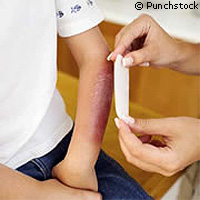
A Swiss research team has found that the application of a biobandage of small number of foetal cells can improve the healing of the wounds of young burn victims. The results are published in The Lancet. The new procedure can produce a speedier and more complete recovery than traditional skin grafts, and also spare patients the trauma of having a graft taken from elsewhere on their body. The source of the healing cells may prove controversial however, coming as they do from an aborted foetus. Skin grafting, where a patch of skin is surgically removed from one area of the body and transplanted to another, is the standard two-step surgical procedure for treatment of deep second and third degree burns. Foetuses have long been known to have remarkable regenerative abilities. Exploring the potential of foetal skin cells in grafts, the team, led by Patrick Hohlfeld of the University Hospital in Lausanne, simply expected the skin cells to act as a graft. But instead the cells seemed to confer restorative powers to the burnt skin, allowing the damaged tissue to heal itself. Professor Hohlfeld and colleagues developed a bank of foetal skin cells from one 4 cm2 donation of foetal skin from the biopsy of a 14-weeks terminated foetus with the mother's written informed consent. They allowed the cells to divide in the laboratory, and then seeded them onto a bed of collagen - an important protein for skin elasticity - and incubated them for two days, allowing them to form a kind of artificial skin. Eight burn victims, ranging in age from 14 months to nine years, underwent treatment. Professor Hohlfeld's team placed tiny strips of cells onto the burn wounds and covered the area with gauze. They changed their dressings every three to four days for three weeks. The treated wounds took an average of 15 days to heal, whereas other burns treatments frequently take up to six times as long. 'The nurses couldn't believe the speed at which these burns healed,' Professor Hohlfeld says. The remarkable flexibility of the skin repaired with the foetal cells meant that the patients recovered full movement of their hands and fingers, the authors add. The patients have been followed for one to two years and, apart from some colour change in some areas, the overall appearance of the healed burns is good, report the scientists. Professor Hohlfeld thinks that the technique could work for adult burns, as well as other wounds. 'We have not tested this healing process in older patients, but there is no reason to think otherwise,' he says. This novel type of therapy is likely to generate some controversy in countries that restrict the use of human embryos in scientific research, since the bandages are derived from the skin cells of aborted foetuses. Professor Hohlfeld notes that, because foetal cells grow well in the lab, the procedure could source several million 100 cm2 patches for transplant from a single foetal biopsy. Co-author Lee Laurent-Applegate comments: 'In view of the therapeutic effects of this technique, along with the simplicity in application, foetal skin cells could have great potential in tissue engineering.' However, several burns experts have declared that even if the technique sounds promising, its usefulness is not yet proved. The BBC has reported the British Association of Plastic Surgeons' doubts on the findings. A statement claims that there is no proof the wounds would not have healed by themselves. Professor Hohlfeld did not entirely reject this criticism, saying that it is clear that the test should be run again. 'For the moment, it is just a pilot test,' he said. A patent application for the procedure has been filed the team.
Countries
Switzerland