


EU project cluster documents best practice in cooperative production networks research
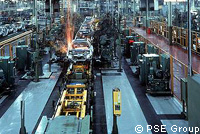
Today, many global industries are characterised by significant overcapacity, and in an environment where supply outweighs demand, customers are demanding better levels of service and products tailored to their own needs. The challenge facing companies is to provide the right products in the right quantity at the right place and time, but as product life cycles become ever shorter while technology evolves ever more quickly, efficient and responsive supply chains are crucial for maintaining competitiveness. These new supply chains are increasingly characterised by networks of cooperating companies linked through novel technologies, and the EU funds a number of research projects in the field of information and communication technologies (ICT) for enterprise networking. A cluster of such projects, known as AITPL (ambient intelligence technologies for the product lifecycle) and funded under the IST priority of the Sixth Framework Programme (FP6), has produced a report documenting the results of their first year of work. The report aims to identify success strategies for further research projects in the field of cooperative production networks, with a particular focus on the automobile sector. According to the report, 'the cluster believes that the strength of the European economy is increasingly based on relationships among many enterprises, which together form agile networks able to react to market demands in the shortest time'. Competitiveness can only be maintained, it continues, if such networks can establish and maintain efficient interactions that cover the complete product lifecycle. As an example, the report cites the Spanish clothing company Zara. The company has what it describes as a 'triple A' supply chain that is able to adapt to changing market conditions, evolving technology and new requirements. Following September 11, for instance, the company was able to coordinate its designers, supply chain partners and manufacturers to launch a new line of black clothing within two weeks, resulting in a large sales shift in their favour. While such seamlessly integrated supply chains are still the exception rather than the rule, collaborative networks are beginning to appear in the automobile sector, says the report. For example, the 'five day car' scenario requires a manufacturing lead-time of just one day, leaving one day to receive orders and coordinate suppliers and three days to deliver the finished vehicle to the customer. In documenting current best practice in this field of research, the analysis focuses mainly on non-technical issues, namely: supply chain integration, small and medium sized enterprise (SME) networks, interoperability and tools to enhance competitiveness. This leads the authors to draw a number of conclusions regarding success factors for research projects in the field of cooperative production networks. First, sector oriented projects must involve a critical mass of partners in order to have an impact, and must also include smaller players in the production chain. For projects tackling the ICT tools that underpin these processes, furthermore, it is important to understand that technical issues are linked to a range of organisational, process, social, economic and cultural issues, and initiatives must therefore be interdisciplinary in nature, with researchers from different areas gathered around a core set of ideas. SMEs feature prominently in the report, and it concludes that smaller players must be included in the standardisation processes that will necessarily accompany the spread of cooperative production networks. This could either be done through the involvement of SME umbrella organisations, or by adapting projects to facilitate the participation of individual companies, for example by maximising the use of electronic communications in order to reduce the need for travel. Finally, the report suggests that: 'A number of projects will produce interesting results which the Commission might want to support with technology diffusion or take-up initiatives, market validation, and initial deployment.' By integrating these recommendations into future research initiatives, the AITPL cluster of projects - ILIPT, SPIDER-WIN, ATHENA, Co-DESNet, NO-REST, V-CES and VERITAS - believes that research in the field of cooperative networked production will help put Europe's manufacturing industry in a competitive and leading position.