


Research a key tool for Croatia's EU integration, argues Potocnik
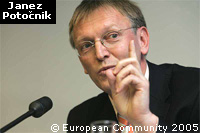
Science and Research Commissioner Janez Potocnik has used a speech to the Croatian Academy of Sciences and Arts to urge the country to give the necessary priority to research in its drive for EU membership. It is one month since the decision was taken to open negotiations with Croatia on the country's accession to the EU, and the Commissioner believes that research will help to boost Croatia's dynamism and smooth its effective integration into the Union. Mr Potocnik underlined the importance of national targets for research investment in the context of the 3 per cent target, but added: 'Of course I understand that Croatia has a low GDP expenditure on research, but at 1.14 per cent compared to the EU average of 1.93 per cent, it has the potential to make rapid progress towards the EU average.' He continued: 'I am please to note Croatia's commitment to work towards the Lisbon research investment goal, although I am informed that neither a target nor a timetable is currently foreseen. [...] I would strongly recommend that Croatia, in preparation for its membership, should already elaborate a national Lisbon programme and set ambitious goals to approach the 3 per cent objective.' Currently, the main gap between Croatia and the EU is in terms of the research and development (R&D) performance of the private sector, and Mr Potocnik said that closing this gap would be a key challenge. Another main objective for the government will be to increase research investment coming from abroad, he added. 'But it is not only a question of more money; we also need qualitative improvements. This requires the creation of clusters and poles of excellence; the development of public-private cooperation should be facilitated, and research careers should be made more attractive.' On this last point, Mr Potocnik pointed to the European charter for researchers and the code of conduct for their recruitment as helpful tools. 'One of the recommendations in the code that I would, for example, urge the Academy of Sciences to help apply is that of advertising research positions internationally.' Finally, the Commissioner pointed to participation in the EU framework programmes as a means for further integrating Croatia into the European Research Area. He noted that the country has already achieved much with very limited means, but underlined the importance of involvement in Networks of Excellence and Integrated Projects in order to derive maximum benefit. 'This is why I am so pleased that your government has taken the initiative of becoming associated to the Sixth Framework Programme for the remaining year 2006. [I]t is a move that will offer genuinely new and interesting research opportunities to Croatia,' concluded Mr Potocnik.
Countries
Croatia