


ESA publishes new results from Mars Express and Huygens
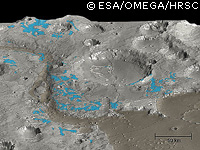
The European Space Agency (ESA) published a series of new results from its Mars Express and Huygens missions on 30 November, including the first ever data on the deep subsurface of the Red Planet. Using the MARSIS (Mars advanced radar for subsurface and ionospheric sounding) instrument on board Mars Express, scientists studied the echoes of radio waves emitted by the radar to build up a picture of the layers beneath the planetary surface. The team found evidence for a buried impact crater some 250 kilometres in diameter, possibly containing a thick layer of water-ice-rich material. 'The detection of a large buried impact basin suggests that MARSIS data can be used to unveil a population of hidden impact craters in the northern lowlands and elsewhere on the planet,' said Jeffrey Plaut, co-principle investigator on MARSIS. 'This may force us to reconsider our chronology of the formation and evolution of the surface.' MARSIS was also used to probe the layered deposits that surround the planet's north pole. Scientists came to the likely conclusion that there is a near-pure, cold water-ice layer over 1 km thick overlying a deeper layer of 'basaltic regolith'. To date, the MARSIS team has not seen any convincing evidence for liquid water beneath the surface of Mars, but the researchers stress that the search has only just begun. 'MARSIS is already demonstrating the capability to detect structures and layers in the subsurface of Mars which are not detectable by other sensors, past or present,' says principle investigator Giovanni Picardi. 'MARSIS holds exciting promise to address, and possibly solve, a number of open questions of major geological significance.' Another instrument on Mars Express, the visible and infrared mapping spectrometer OMEGA, has detected two types of hydrated minerals on the planet's surface - phyllosillicates, such as clay, and hydrated sulphates - which point to the long-term presence of large amounts of liquid water on Mars at some point in its early history. 'An early active hydrological system must have been present on Mars to account for the large amount of clays, or phyllosilicates in general, that OMEGA has observed,' said Jean-Pierre Bibring, the instrument's principle investigator. The discovery of two different types of hydrated minerals suggests two major climatic episodes in the history of Mars: an early moist environment, in which the phyllosilicates formed, followed by a more acid environment in which the sulphates formed. 'If we look at today's evidence, the era in which Mars could have been habitable and sustained life would be the early Noachian [lasting from the planet's birth to around 3.8 thousand million years ago]. The clay minerals we have mapped could still retain traces of a possible biochemical development on Mars,' concluded Professor Bibring. ESA also published results from the Huygens probe, which landed on the surface of Saturn's largest moon, Titan, on 14 January 2005 having been transported there by the NASA/ESA/ASI spacecraft Cassini. Clear images taken by the probe during its parachute descent show strong evidence for erosion due to liquid flows on Titan, most probably of methane. Water-ice pebbles up to a few centimetres in diameter were scattered near to the probe's landing site, and the surface was found to have the consistency of loose, wet sand. Huygens surprised scientists by finding a second lower ionospheric layer to Titan's atmosphere, and its instruments may also have recorded lightning. Having studied both the atmosphere and surface of Titan, Huygens was able to confirm the presence of a complex organic chemistry in both, reinforcing the theory that Titan is a promising place to study the chemical pathways of molecules that may have been the building blocks of life on Earth. Argon 40 was also detected at the surface, indicating that Titan has experienced in the past, and is most likely still experiencing today, internal geological activity.