


Scientists doing 'a mediocre job' of communicating, says Descartes Laureate Bryson
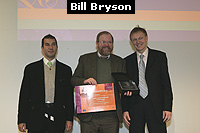
That he could write one of the bestselling science books in recent years says much about the talents and popularity of author Bill Bryson, self-confessed science dunce and winner of the 2005 Descartes Prize for Science Communication. Yet, when an author with absolutely no scientific qualifications claims the EU's highest honour for popularising science through the written word, perhaps it also says something about the general level of communication skills within scientific community itself. That was what Mr Bryson appeared to suggest when CORDIS News spoke to him at the Royal Society in London after he had picked up his award. 'They should be doing more to engage with the wider world,' said the US-born writer. 'Scientists are doing a fairly mediocre job of communicating science, and its up to them to do something about it.' His inspiration for writing the book was born out of a conviction that 'science must be interesting', despite 'always being confused and bored by it at school', revealed Mr Bryson. 'Education is the place to start. Textbooks shouldn't be written like PhD theses - there's no reason why we can't make them interesting. So much science is inherently interesting, and more effort is needed to get that across,' he began. In addition, schools should teach science to pupils in two different ways, believes Mr Bryson: 'It has to be taught seriously, to encourage more young people to become scientists, but you also need to teach 'normal' people the wonder of science - you should be getting that even if you're never going to be a scientist.' A fellow winner of this year's Descartes Prize for Science Communication was Tübingen University's 'Kinder-Uni' initiative, which Mr Bryson described as a great idea that should be expanded. 'It benefits both directions too, as getting an academic to keep kids interested in a scientific subject for 45 minutes would teach them a lot about effective communications,' he said. CORDIS News asked Mr Bryson whether he felt that he had the advantage, as a non-scientist, of being able to treat the subject with more levity than an expert might ordinarily be expected to. 'Scientists have to do serious science, and that's a serious responsibility,' he agreed, 'but in the wider world they could learn to let their hair down a bit.' But whatever the collective failings of scientists as communicators, Mr Bryson was effusive in his praise of all those that helped him with the book. 'One to one, I found scientists wonderful at communications - sure, some would get way too detailed - but they were all very generous and patient, even when they had to explain things to me over and over and over again.' He gave the example of 'Moss Man' Len Ellis, Bryophyte Curator at London's Natural History Museum. 'Before meeting him, I would have bet that mosses couldn't be interesting - but they are! I came away thinking: 'wow'.' Nevertheless, Mr Bryson retains a sneaking suspicion that if most of the scientists he spoke to had had to write 'A Short History...' they would have reverted to complex jargon almost immediately. 'It just seems to be a general failing of academics that they are unable to convey the excitement of their work,' he said. Asked whether he intends to continue working on scientific subjects, the author told CORDIS News: 'In the sense of a book, I think that's it for me and science. But, although it really surprises me, I'm still reading Nature - not the formal research papers, but the magazine stuff - and I'm genuinely interested in science in a way that I never was before.' Mr Bryson stresses that science needs to be communicated, and for that reason he hopes that the Descartes Prize will be continued. His final message was for those scientists hoping to communicate their work to the wider world: 'Don't lose your sense of wonder and don't forget the wow factor. It's the same in all walks of life, but for scientists, who might not be the best communicators, to forget these can be particularly tragic.'