


Young researchers highlight value of Commission's human resources initiatives
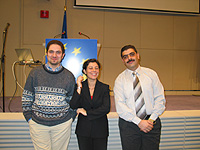
Much is made of the so-called brain drain of European researchers to other parts of the world, particularly the US. But according to the Commission, the most pressing concern is the high number of science and engineering (S&E) graduates who choose not to pursue a career in research. The EU produces almost twice as many S&E graduates as the US each year and more than double the number of doctorates, yet the total number of active researchers in each region is roughly the same. 'The problem is not that researchers are going elsewhere, but that they are leaving for other careers - not so much 'brain drain' as 'brain wastage',' according to the Commission's spokesperson for research, Antonia Mochan. This fact explains why the primary objective of the Commission's human resources strategy for scientists is to raise the overall attractiveness of research as a career in Europe, and on 14 December three young scientists were invited to Brussels to explain how EU initiatives had helped them to launch their research careers. Sofia Calero currently heads her own research team looking into computational approaches to the design of nanomaterials at the University Pablo de Olavide in Seville, Spain. Following her doctoral studies in Madrid she got her first break in research in the Netherlands with the help of a two-year Marie Curie Fellowship. 'I was very lucky to get a Marie Curie Fellowship, as it gave me the opportunity to be an independent researcher for the first time,' said Dr Calero. 'The Commission allowed me the chance to develop my own ideas, and offered me stability for two years while in the Netherlands.' After this time, Dr Calero received another Marie Curie grant which enabled her to return to Spain, and through a national programme she was offered a five-year contract and the chance to establish her own research group. 'I am very happy, and now I have a very good career,' said Dr Calero. Indeed, in recognition of the excellence of her group's research, she was recently awarded a Marie Curie Award for mobile research excellence, which will provide even more stability. But Dr Calero stresses that in this respect, she is the exception rather than the rule: 'My complaint is about the lack of stability for young researchers in Europe - you cannot do real research if you have to move every five years.' While her own career is going from strength to strength, Dr Calero points to many of her contemporaries who have turned their backs on research. 'Spain created a lot of PhDs, but then found that it couldn't absorb all of us. It's true that there is a programme now to bring back Spanish researchers from overseas by offering them a five year contract, but my question is what will they do with them after the five years?' Aside from the Marie Curie programme, another major initiative launched recently by the Commission was the publication of a Charter for European Researchers and a Code of Conduct for their recruitment. Francis Vella, a young postdoctoral researcher and President of EURODOC, a European federation of national associations representing up to half a million young researchers, describes the Charter and Code as a milestone on the way to improving conditions for young researchers in Europe. 'The Charter and Code are designed to enable quality, career-driven mobility rather than forced mobility,' said Dr Vella. 'They will offer a hallmark of quality for researchers who are looking to move to different countries or institutions.' He described the initiative as a subtle way of dealing with the challenge of improving research careers, as although there is no obligation for Member States or organisations to adopt the Charter and Code, he believes they will give a competitive advantage in attracting the best researchers. Asked whether he believes the Code and Charter have directly contributed to significant organisational change in Europe yet, Dr Vella told CORDIS News that it was still early days. 'We are seeing more and more institutions and countries committing to the Charter and Code, and we will try to monitor whether institutions are making the necessary changes when they sign up, but it is still too early to say yet.' Overall, however, Dr Vella said that the Charter and Code are both seen in a very positive light by Europe's young researchers. Finally, Abufahra Saba, a young medical researcher from Palestine who is currently working at a research hospital in Liège, Belgium, described how his move to Europe had been made significantly easier with the help of one of Europe's network of mobility centres, established in 2004 by the Commission. As well as helping to organise his visa and other administrative issues, Dr Saba said that the centre 'even got involved in simple things like arranging health insurance and helping to buy a car'. Ultimately, all three young researchers seemed to agree that the most important ingredient that is often lacking from a research career in Europe is stability. 'Most people I know would be happier with more stability rather than more salary,' Dr Vella told CORDIS News. 'There will be the issue of salaries at some point, but a lack of stability directly affects your family life and the research itself. When someone leaves a lab, they take their knowledge with them, so the problem doesn't just affect individuals but institutions too.' With initiatives such as the Marie Curie actions, the Charter and Code, and its network of mobility centres, the Commission is trying its best to offer more stability to young scientists in Europe, and to persuade them that a career in research is in everyone's best interests.