


First Galileo satellite in orbit
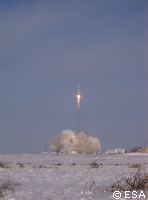
Europe's satellite navigation system got off the ground on 28 December with the launch of the GIOVE-A satellite, the first Galileo demonstrator. The launch took place in Baikonur, Kazakhstan, atop a Soyuz-Fregat vehicle. The launch has been applauded by many, including EU Transport Commissioner Jacques Barrot, who declared: 'radionavigation based on Galileo will be a feature of everyday life, helping to avoid traffic jams and tracking dangerous cargos, for example. The launch of GIOVE [...] is the proof that Europe can deliver ambitious projects to the benefit of its citizens and companies.' Once in place, the 30 satellite constellation, designed specifically for civil use, will offer state-of-the-art global positioning and timing services. The full cluster is expected to be in operation by 2010. The 600kg GIOVE-A satellite, built by Surrey Satellite Technology Ltd (SSTL) of Guildford, in the UK, has three objectives: it will secure use of the frequencies allocated by the International Telecommunications Union (ITU) for the Galileo system; demonstrate critical technologies for the navigation payload of future operational Galileo satellites; and characterise the radiation environment of the orbits planned for the Galileo constellation. GIOVE A carries two redundant, small rubidium atomic clocks, each with a stability of ten nanoseconds per day, as well as two signal generation units. One unit is able to generate a simple Galileo signal, while the other generates more representative Galileo signals. These two signals will be broadcast through an L-band phased-array antenna designed to cover all of the visible Earth under the satellite. Two instruments will monitor the types of radiation to which the satellite is exposed during its two-year mission. A second demonstrator satellite, GIOVE B, built by the European consortium Galileo Industries, is currently undergoing tests, and will be launched in the spring. It will demonstrate the Passive Hydrogen Maser (PHM), which, with a stability better than one nanosecond per day, will be the most accurate atomic clock ever launched into orbit. Two PHMs will be used as primary clocks onboard the operational Galileo satellites, with two rubidium clocks serving as backups. Galileo is being seen by some as a rival to the US' Global Positioning System (GPS) and Russia's Global Navigations Satellite System (Glonass). Although use of GPS is free and accessible to all in geographic terms, its design means that it is optimised for the US. Also, the system can be ten metres or so out in terms of accuracy. Galileo is accurate within one metre. The US system can also be switched off at the request of the US President. Indeed, in 2004 President George Bush ordered that the satellites be temporarily disabled during national crises in order to prevent terrorists from using navigational technology.