


Commission proposes two-tier structure for EIT
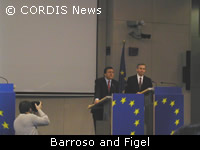
The European Commission has unveiled its draft plans for creating a European Institute of Technology (EIT), based on a two-tier structure consisting of a central governing board and a network of seconded 'knowledge communities' from universities, research centres and companies across Europe. The proposals were presented on 22 February by Commission President José Manuel Barroso, and followed a public consultation that collected over 700 contributions. The majority of respondents called for the EIT to be based on a network of some kind, he said, but a significant number - around a quarter - thought it should be a single institution, if not necessarily based on a single site. '[C]oncern was expressed that a fixed network of universities would offer neither the flexibility and openness required nor a sufficient level of integration. Nor would it reflect the fact that excellence often lies in individual departments or teams, not whole universities,' the proposals explain. Thus, the 'knowledge community' model is designed to overcome these concerns while still reflecting the fact that a majority favour a network approach. The knowledge communities will consist of whole departments or teams from partner organisations that are seconded to the EIT for a period of 10 to 15 years, becoming legally separate from their host institution or company. The EIT's mission, according to President Barroso, will be to combine the three sides of the 'knowledge triangle' - education, research and innovation. It will offer education of the highest international standard; carry out basic and applied research in transdisciplinary areas with a particular industry focus, and build strong links with industry to ensure its work leads to an increase in innovation. 'We plan to create a unique European institution unlike any other current of planned EU initiative,' said Mr Barroso, emphasising the clear delineation between the roles of the EIT, the framework programmes and the European Research Council (ERC). 'The EIT will add value to what is already being done in the EU, Member States and universities, and establish a new relationship between education, research and business. It will be a flagship and a symbol for Europe, but more than that it will also do concrete research and produce concrete results.' Education and Training Commissioner Ján Figel' went into more detail regarding the proposed structure. The knowledge communities will be selected on a competitive basis, he said, and will focus on up to 10 strategic areas of transdisciplinary research such as biotechnology, nanotechnology, and green energy. The governing body, meanwhile, will form the core of the EIT, defining its overall strategy, selecting, monitoring and evaluating the knowledge communities, and managing the budget. On the vital question of financing, the Commission believes that 'substantial public funding' from the EU and Member States will be required initially, but that as knowledge communities develop they will be able to raise resources from other competitive sources of public funding as well as from businesses, endowments and other fees. 'Attracting additional finding would be an objective, with milestones, in every agreement between the EIT and a knowledge community partnership,' the proposal states. For such a model to succeed, the Commission is aware that participation in the EIT must be sufficiently attractive for universities and research institutes. Potential returns for partners willing to contribute their best teams will include increased visibility and prestige, a privileged partnership with the best minds in a particular field, financial incentives in the form of resources for capacity building, and knowledge transfer. The Commission understands that to achieve its objective of boosting innovation in Europe, the participation of businesses will be a decisive factor. It hopes that having an opportunity to influence the direction of cutting-edge research and securing guarantees that they will be able to commercialise the results will act as a sufficient draw for the private sector. Both Mr Barroso and Mr Figel' stressed that the Commission's proposals were exactly that - proposals - and that the suggested model is not set in stone. The plans will be forwarded to the Council for consideration at its next meeting 'We want to secure the political endorsement of the Member States, to see if they are really serious about this, and then the details can be developed later,' said Mr Barroso. Initial reaction to the proposals was mixed. At a press conference in the European Parliament, MEPs Jerzy Buzek and Jorgo Chatzimarkakis, rapporteurs on the FP7 and CIP proposals respectively, welcomed the communication, and praised the Commission for taking onboard the suggestions of MEPs in their work. 'The effort to differentiate between the roles of the EIT and ERC, with clear distinctions mentioned, is particularly welcome,' said Mr Chatzimarkakis. Nevertheless, the MEPs believe there is room for improvement in the Commission's plans, and their main concern is a belief that the proposals fail to explicitly underline the EIT's main focus on innovation. 'Europe is already strong in research, but innovation is the missing link - that's the gap that the EIT should bridge,' continued Mr Chatzimarkakis. Mr Buzek stressed that the EIT must not divert resources from the framework programme, CIP or the ERC, and neither should it seek to compete with other universities in Europe. 'It is not a new university, it is a quite different idea all together,' he said. The two MEPs also expressed doubts as to whether universities, research institutions and businesses would be happy to let their best teams become legally divorced from their organisations for a decade or longer. 'These issues require further discussion in the European Parliament and across the EU,' concluded Mr Buzek. 'The first step by the Commission is very good, but the debate has only just started.' Other stakeholders were less welcoming of the plans, however. Dr David Livesey, Secretary General of the League of European Research Universities (LERU), told CORDIS News: 'We are still awaiting an argument in favour of the EIT based on a firm understanding of the innovation process, and an explanation of why what is being proposed will make a difference.' A spokesperson for European employers' federation UNICE added: 'We think the Commission should focus on FP7 and the ERC at the moment - they are more important. If there are spare funds available for the EIT, divert them towards these other programmes.' Universities UK President Drummond Bone added: 'We welcome the Commission's continued commitment to improving growth through research and development but an EIT is not the right vehicle for this objective. If these plans go ahead, they will threaten the EU's goal of boosting research and development efforts, by distracting resources and efforts away from existing proposals to back high-level research through [the ERC] and through the framework programme.'