


Barroso calls for focus on four priority areas for competitiveness
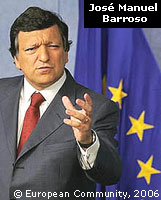
Commission President José Manuel Barroso has called on Member States to focus their efforts on four priority areas for competitiveness between now and the end of 2007 - knowledge creation, unlocking business potential, more and better jobs, and an integrated European energy strategy. Speaking at the fourth European Business Summit (EBS) in Brussels on 16 March, Mr Barroso welcomed Member States' response to the recent national reform programme exercise (NRP), saying it was the first time that 25 governments had presented economic reforms simultaneously and submitted to some form of common monitoring. 'Not all the NRPs are equally ambitious, but they provide a basis to see whether Member States are delivering or not on what they promised,' believes Mr Barroso. Looking ahead to the Spring European Summit, the President said: 'What do I expect from EU leaders? Courage, ambition and above all action.' Mr Barroso was aiming to provide a focus for this action when he outlined the four areas that the Commission would like to see prioritised over the next two years. In terms of knowledge creation - the first of these four priority areas - he emphasised the importance of supporting higher education and research. The President reiterated his desire to see the creation of a European Institute of Technology (EIT), and said that he expected the Council to offer its strong support for the initiative at its summit meeting. In terms of improving the environment for businesses in Europe, and particularly for small and medium sized enterprises (SMEs), Mr Barroso stressed that this was a job for both the EU and its Member States. He underlined the Commission's contribution through its 'better regulation' exercise, and called on EU governments to make it easier to set up new companies. Providing more and better jobs in an increasingly globalised economy means that Member States must try to offer all young people work or an apprenticeship within six months of leaving school or university, said Mr Barroso, and he emphasised the importance of lifelong learning and training for workers of all ages. Lastly, in the field of energy the President stressed that the Commission's recently launched Green Paper offered an integrated strategy for Europe grounded on the principles of maintaining competitiveness, providing environmental protection and ensuring security of supply. Efforts to move to a low carbon economy would also mean more innovation in Europe, Mr Barroso added. The Commission President finished by stressing that the support of the business community was crucial to the process. 'If at the Council, Europe's leaders agree to deliver these measures and their NRPs, we will see real progress on growth and jobs. But we need the support of business leaders to make it a real strategy,' he concluded. Earlier, Prime Minister of Belgium Guy Verhofstadt suggested that the Commission was right to propose a focus on four priority areas for action because 'Europe is still struggling to compete globally, and is moving further away than ever from its goal' of becoming the world's most competitive knowledge-based economy by 2010. Mr Verhofstadt underlined some of the measures that his government is introducing in these areas, for example making it possible to establish a new company in just three days and reforming the corporate tax rules to create exemptions for investments in R&D and innovation. These and other initiatives are beginning to produce tangible results, he added, with Belgium climbing up the EU rankings for competitiveness performance. 'Belgium is not alone in pumping new life into the economy, and the point I would like to make is that national efforts and NRPs are not sufficient alone,' Mr Verhofstadt continued. 'We need a proper European economic strategy that goes beyond the open method of coordination currently used in the Lisbon agenda, and we must step up economic governance within the EU, or at the very least in the euro zone.' As part of this economic strategy, Mr Verhofstadt foresees increased fiscal harmonisation, with minimum and maximum taxation levels being set within the EU, a common R&D strategy, and a streamlined system for intellectual property based on a European Patent. 'I'll say it again, but it's hardly surprising that researchers are fleeing the EU where it costs three to five times as much for a patent as in the US.' The Belgian Prime Minister concluded by saying: 'I'm not pessimistic, as I see many countries working hard with the EU to reform their economies and boost competitiveness. But I am a realist [...] - either we persist with the open method of coordination or we opt for a real European economic and social strategy, which I think is the only way out of the current crisis. I will be making the same point at the European Council next week.'
Countries
Belgium