


EU leaders give their backing to Commission's relaunched Lisbon agenda
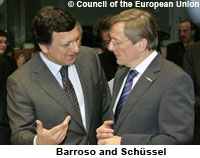
The European Council has endorsed the Commission's proposal to focus on four priority areas for competitiveness between now and the end of 2007, following its summit meeting in Brussels on 23 and 24 March. Commission President José Manuel Barroso welcomed the outcome of the summit, saying that the relaunched Lisbon agenda for growth and jobs is now up and running. 'Now the focus is on implementation,' he added. Heads of State and Government agreed that over the next 18 months, the EU should focus on investments in knowledge and innovation, unlocking business potential - particularly in small and medium sized enterprises (SMEs) - increasing employment opportunities and creating environmentally stable growth. Leaders also emphasised the need to maintain the momentum generated in the National Reform Programme (NRP) exercise by ensuring their 'effective, timely and comprehensive' implementation. In terms of increasing investment in knowledge and innovation, the Council welcomed the setting of national targets for research and development (R&D) and urged Member States to carry on working towards the three per cent target agreed in Barcelona in 2002. It also noted the findings of the Aho report on building a more innovative Europe, and invited the Commission to assess the report's recommendations with a view to creating a 'broad-based innovation strategy for Europe'. A spokesperson for Research Commissioner Janez Potocnik described the Council's desire to see the Commission act on the Aho report as a very important signal. The Council conclusions continued by emphasising that more still needs to be done to coordinate the activities of the EU's research framework programmes with other European and national actions. They also called for the remaining barriers to geographical and sectoral mobility for researchers to be overcome. The Commission welcomed the Council's support for the creation of a unified labour market for researchers, saying that whilst it is not a new issue, it is one that can get overlooked. On the subject of President Barroso's vision of a European Institute of Technology (EIT), the Council agreed that creating such a body would be 'an important step to fill the existing gap between higher education, research and innovation'. The eventual structure of the EIT is still not clear, but initial reports suggested that EU leaders are in favour of a network of existing institutions rather than concentrating activities in a single central institution. Mr Potocnik's spokesperson stressed that however discussions on the EIT proceed there is no possibility that the initiative will divert resources from the European Research Council, and noted that the Council conclusions call for the ERC to have a guiding role in the establishment of an EIT. The Council asked the Commission to submit more detailed proposals on the EIT before its next meeting in June 2006. Under the other three priority areas, the Council conclusions offered further support for a number of the Commission's recent proposals. In order to unlock the business potential of SMEs, the Council supported the principle of 'think small first', and endorsed the target that by the end of 2007, all Member States should establish one-stop-shops for setting up a new company within a week. Before the summit, the Commission also urged that by the end of 2007 all young people should be offered a job, apprenticeship or additional training within six months of leaving school, and the Council supported this vision, saying that the six month time limit should fall to four months by 2010. This will have been welcome news for the President of the European Parliament Josep Borrell who, in his speech to the Council, said: 'If there is any one objective to be highlighted in your conclusions [...] let it be this one.' The Council also welcomed the Commission's recent Green Paper on a European Energy Policy, and called for the promotion of eco-innovation and environmental technologies through a targeted action plan. In encouraging employment opportunities, the Council conclusions endorsed an approach that balances job flexibility and security, along the lines of the 'flexicurity' principle put forward by European businesses in the run up to the summit. While some reports in the wake of the summit meeting criticised the Council for not setting more clear and binding targets under the four priority areas, Mr Potocnik's spokesperson played down those concerns. 'The Council reiterated the three per cent target, which is the top target that we have,' she told CORDIS News. 'If people are prepared to do the things they've said they will do, that's the most important thing. If they are, then they will do it whether there are targets in place or not.'