


Panel gives thumbs up to EU's framework programme for research
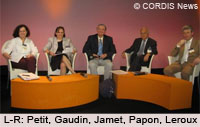
The launch of Seventh Framework Programme (FP7), planned for 1 January 2007, will mark the 20th anniversary of the birth of the framework programme, and is leading some to reflect on the programme's development. During the European Research and Innovation Exhibition in Paris on 10 June, Paul Jamet, Coordinator of the French National Contact Point, led a televised debate between experts in which he invited them to share their experience of the programme and thoughts on how it should progress in the future. 'The research framework programme is now sufficiently mature and stable for us to take stock of the situation and diversify the programme's objectives, tools and instruments,' said Jocelyne Gaudin, Advisor to the European Commission on the future of European research. Since the first framework programme was established in 1986, the Commission has progressively introduced a diverse number of tools and instruments to support cooperation between research groups from different Member States. With an amplified budget of EUR 50 billion, FP7 aims to continue to respond to the changing needs of the research community, said Ms Gaudin, by diversifying further its support infrastructures. It foresees, for instance, the creation of an independent European Research Council (ERC) to boost European basic research and continued efforts to support the development of European Technology Platforms (ETPs). Testifying to the programme's success was Christine Petit. She is Director of a research unit at the French National Institute for Health and Medical Research (INSERM) and Coordinator of EuroHear, an Integrated Project funded under the section 'Life sciences, genomics and biotechnology for health 'of the Sixth Framework Programme (FP6). The research undertaken by the 21 European partners in the project has already brought to light the prominent role of heredity in isolated (non syndromic), congenital or early-onset childhood forms of deafness. 'Without the support of the EU, this research would never have got off the ground for a number of reasons,' said Ms Petit. 'Given the magnitude of the research, which required the involvement of many different disciplines, national programmes just do not have the financial resources to do this kind of research,' she said. Also, the very nature of the research required the involvement of researchers from several different disciplinary backgrounds. 'No one national programme can bring these disciplines together,' she said. Furthermore, working with partners together on the project ensured that competition did not get in the way of our mutual objective, which was to differentiate the genes for deafness,' said Ms Petit. Thierry Leroux, Director of ELDIM, a small to medium sized enterprise (SME) manufacturing innovative instruments for the display industry, gave his view. He is one of the partners in MAESTRO, also an Integrated Project that is researching and developing methods and advanced equipment for simulation and treatment in radio oncology. 'Research like this can sometimes be a very long process,' he said. 'The framework programme offers the team in which I work a very stable funding environment. As an entrepreneur and researcher, the project environment is ideal: 'I get to meet other researchers in the domain off whom I can bounce ideas, but it also gives me a chance to meet my clients to make sure that the money we are spending on research is not wasted on the wrong direction.' While the programme has certainly led to a better structuring of research at a European level, the scientific community should not overlook the other important infrastructures that are complimentary to it, said Pierre Papon, former Director of the French national centre for scientific research (CNRS). He referred to a number of both public and private organisations that are working at a European and an International scale, the funding for which, he said, is not negligible. These include the European Organisation for Nuclear Research (CERN), the European Space Agency (ESA), and the EU's satellite navigation programme (Galileo). He welcomed work by the European Commission and these big agencies to synchronise their efforts. 'But something is missing,' said Mr Papon. 'There is a noticeable lack of coordination between the European framework programme and national programmes. He looked to nanotechnologies, a theme present both at national and international level, and regretted the fact that there are no visible tools in place to develop a concerted action to co-finance such large programme areas. Indeed, Ms Gaudin said that a lot of work goes on behind the scenes between the Commission, Member States and the research community. She gave the example of the identification of themes for inclusion in the programme's calls for proposals. 'So a lot of natural cooperation exists which is of course not that visible when the calls are published in the Official Journal,' she said. 'But there are many examples of more 'institutionalised cooperation', like the mobility of scientists,' added Ms Gaudin. In 2001, the Commission and Member States adopted a common strategy aimed at improving researchers' mobility in Europe and ensuring that they have access to training and career development opportunities at all stages of their professional life. She also gave the example of the recent introduction of the 'scientific visa', which foresees the free movement of researchers from third countries within the EU, the European Charter for Researchers, and the Code of Conduct, both of which were based on coordinated work between Member States and the Commission. Asked by a member of the audience why Article 169, which enables the Community to participate in research programmes undertaken jointly by several Member States, had hardly been used, Ms Gaudin referred to the complexity of the procedure. Each proposal requires a co-decision by the Council and the Parliament, a similar process to the framework programme. Only one Article 169 initiative exists, the European and Developing Countries Clinical Trials Partnership (EDCTP), which Ms Gaudin said was very ambitious, given that it brings together not only EU Member States and Norway, but also developing countries, other donors and industry in a joint effort to combat poverty-related diseases. An alternative is ERA-NET, a scheme worth EUR 148 million under FP6 that aims to provide targeted support for the coordination and mutual opening up of national and regional research programmes. It also aims at establishing long-term cooperation between national programmes, ultimately leading to joint transnational research programmes. ERA-NET is less ambitious and much simpler as it does not require a political agreement. But it is attracting a lot interest, concluded Ms Gaudin. It is expected that by the end of FP6, some 75 ERA-NET projects will be up and running. The first ERA-NETs are already changing the landscape of European research in a wide range of fields, while some of them are in the process of launching the first joint transnational programmes and joint calls.
Countries
France