


Ocean census hints at immense diversity of marine microbes
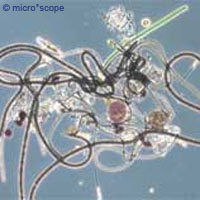
A new study has revealed that the biodiversity of marine microbes could be far higher than previous estimates suggested; researchers from The Netherlands, Spain and the US found over 20,000 different kinds of bacteria in just one litre of seawater. Marine scientists are fond of pointing out that we still know less about the oceans than we do about the surface of the Moon. This latest research is part of an international project which aims to change that; the Census of Marine Life brings together over 1,700 researchers in over 70 countries in efforts to assess and explain the diversity, distribution and abundance of life in the oceans. In the present study, the researchers took samples of seawater from a range of depths at eight sites in the Atlantic and Pacific Oceans. Sampling locations included a hydrothermal vent on an underwater volcano in the Pacific, and several sites between Greenland and Ireland. They were able to identify so many different microbes thanks to a new DNA technique called '454 tag sequencing', which requires only small snippets of genetic code to identify and organism. According to the scientists, 454 tag sequencing is doing for biology what the Hubble telescope did for astronomy. 'Peering through a laboratory microscope into a drop of seawater is like looking at the stars on a clear night,' said Victor Gallardo, Vice-Chair of the Census of Marine Life. 'We can see microbial diversity to which we were blind before.' The researchers were staggered by the number of species their research revealed. 'These observations blow away all previous estimates of bacterial diversity in the ocean,' commented Mitchell L. Sogin, of the Marine Biological Laboratory (MBL) in Woods Hole, Massachusetts. 'Microbiologists have formally described over 5,000 microbial species. This study shows we have barely scratched the surface. The number of different kinds of bacteria in the oceans could eclipse five to ten million.' The researchers observed that while a small number of species dominated all the samples studied, most of the diversity was due to thousands of populations of rarer types of bacteria. The scientists believe that these rarer microbes could be keystone species, playing an important role in the community, for example by producing an essential compound. Alternatively, they could represent a reserve of genetic innovation, which could take on a more significant role if the environment changes. 'We cannot know the implications of a major, long-term environmental shift if we do not know what species were there to start with,' explained Julie Huber of the MBL. 'What is rare in one environment may prevail in another. And if major environmental changes do occur, these low-abundance microbes may become dominant.' Dr Sogin underlined the importance of microbes, pointing out that they make up the vast majority of marine biomass and are the primary engines of Earth's biosphere. 'They are the primary catalysts of energy transformation, and fundamental to the biogeochemical cycles that shape our planetary atmosphere and environment,' he noted, adding that all multi-cellular life depends upon microbial processes. 'The microbes can live without us but we are totally dependent upon them for our survival.' The MBL now has funding to analyse samples from 1,200 marine sites, which will include surface waters, water near methane seeping from the sea floor and deep sea sediments.