


Barroso urges Europe to embrace globalisation, and invest more in research
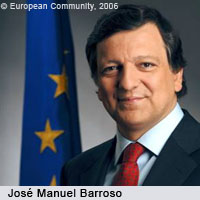
European Commission President José Manuel Barroso has called for Member States to put an end to the 'spectre of Europessimism' which presently hangs over the EU, and to collectively confront the challenges of globalisation. To remain competitive globally would require, among other things, greater investment in research and innovation and a tool like the proposed European Institute of Technology (EIT) to incubate excellence, he said. Speaking at the Summer Academy of MEDEF, France's largest business union, on 29 August, Mr Barroso said that globalisation has resulted in an interdependence between countries never seen before, where service, goods and financial markets have all become 'transnationalised'. This shift in paradigm is further affected by the information and communication technologies (ICT) revolution and increasing global mobility. The complex nature of globalisation presents many challenges, especially to the local status quo that has resisted it for a long time. 'But let's be clear, trying to ignore globalisation, especially in Europe, which is the world's biggest trading power, would be absurd. It would be like trying to ignore the digital revolution in 2006. 'New realities need new responses,' said Mr Barroso. 'And we, the politicians, business leaders, scientists, intellectuals and civil society have to find new ways to continue to overcome these challenges successfully. We need to embrace globalisation.' The President pointed to one such reality, the shift towards a knowledge economy, in which the focus is on human capital, products and services with high added value. It requires investment in people, research, and life-long learning in order to stimulate innovative and European businesses. 'These conditions are essential to our competitiveness,' said Mr Barroso. Coupled with this investment, Mr Barroso noted that Europe also needs a flexible tool to translate research efforts into marketable products, and stimulate innovation and excellence at a European level. This is the idea behind the European Institute of Technology, he said, the establishment of which is still under discussion. 'It will bring together three poles of the knowledge economy: businesses, large and small; researchers and universities,' said the Commission President. Other areas which the President said needed to be addressed included reforming the labour market to ensure flexibility; job security; taking global market forces into consideration at national, regional and local levels; and respecting diversity within the Union. He referred to the Lisbon Strategy, which he declared the 'best, most coherent, structured and responsible answer' to the range of these common challenges facing Europe. Re-launched in 2005, the Lisbon Strategy is intended to make the EU 'the most dynamic and competitive knowledge-based economy in the world capable of sustainable economic growth with more and better jobs and greater social cohesion, and respect for the environment, by 2010'.