


Young Scientist contest winners announced
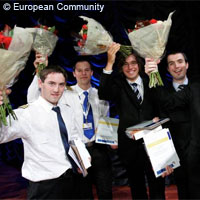
Budding young researchers from around Europe picked up prizes on 27 September when the winners of the European Union Contest for Young Scientists were announced. The three top prizes went to projects in de-icing aircraft, the flight curves of table tennis balls, and potential ß-blockers. European Science and Research Commissioner Janez Potocnik congratulated the winners, saying: 'Science knows no boundaries, and that includes age. What we have seen today shows the innovative and questing spirit of our young people. I offer my warmest congratulations to all of you who participated in the contest and of course, the prize winners. I very much hope that you will all continue to enjoy the thrill of invention and discovery, now and throughout your lives.' The winners were chosen from a field of 120 young scientists, aged between 15 and 20, from 33 countries. Professor Jane Grimson of Trinity College Dublin headed the jury charged with choosing the winners. From the total prize pot of €28,500, the three winning teams received €5,000 first prizes. The winners were as follows: Michael Kaiser and Johannes Kienl of Austria were recognised for their development of a completely new de-ice system for aircraft. The system can be used to de-ice all the important airfoils of aircraft and wind power stations, and can be attached to an aircraft's wings, vertical and horizontal stabilisers, as well as the rotors of wind power stations. An expanding, heated metal layer is used to push existing ice off an aircraft's wings, so that heat and power are required only when ice exists - this is where the system differs from traditional anti-ice systems. Conventional systems require constant heat, even when the plane is in a danger zone. The inventors both 19 years old, and list their desired career as 'pilot'. Alexander Joos and Johannes Burkart from Germany, aged 19 and 20 respectively, also picked up €5,000 for their project on the flight curves of table tennis balls. Both intend to follow a career in physics. Table tennis is one of the fastest sports in the world, but professionals are able to place balls right on the edge of the table, as well as apply topspin. The project was an attempt to understand and simulate the curve of a flying ball. The young scientists started by analysing with a computer the balls coming out of a training machine. They then compared flight curve experiments and simulated trajectories, eventually imitating real table tennis situations. The final winner of the first prize was 19 year old Tomasz Wdowik from Poland, who collected the prize for his project 'Synthesis of 1-(7 -methoxy-1H-indol-4-yloxy)-3-[2-(methoxyphenoxy) ethylamino]propan-2-ol, potential ß-adrenoreceptor antagonist'. One of Europe's biggest killers is heart disease. One method for combating the disease is to treat patients with ß-blocker drugs, including propanolol and metoprolol. Wdowik carried out a complex organic chemistry synthesis of a new compound that could extend the family of ß-blockers. He also provided a description of how the known ß-blockers work. Scientists from Germany, Poland and Hungary shared the second prize (€3,000) for projects on spectroscopic binaries, geometric transformation, and the apoptosis programme. Third prizes (€1,500) went to researchers from Bulgaria, Ireland and the Czech Republic for projects on measurement methods, a food spoilage indicator, and wheat leaf colour changes. In addition, a number of entrants won expenses-paid visits to the European Patent Office (EPO), the Umeå Plant Science Centre, and each of the seven members of EIROforum: - CERN - the European Laboratory for Particle Physics; - EFDA - the European Fusion Development Agreement; - EMBL - the European Molecular Biology Laboratory; - ESA - the European Space Agency; - ESO - the European Southern Observatory; - ESRF - the European Synchotron Radiation Facility; - ILL - the Laue-Langevin Institute.