


Europe to get Extremely Large Telescope by 2018?
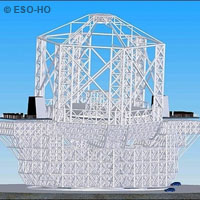
The European astronomical community has reached a consensus on the technical specifications for what will be the world's biggest optical and infrared telescope. The partly EU-funded project for a European Extremely Large Telescope (E-ELT) should have a budget of about ¿1 billion for the European Southern Observatory (ESO) to build the ground-breaking telescope with a 42-metre diameter composite. The consensus reached by the astronomers at their meeting has now been put to the Council of the European Southern Observatory (ESO), which is expected to give its go ahead in the coming weeks. If approved, the E-ELT could start observing the first billion years of the Universe in greater detail than the Hubble Space Telescope by 2018, and would allow the study of the atmospheres of extrasolar planets. According to Dr Henri Boffin, the press officer of the European Southern Observatory (ESO), 'There was a clear consensus from the European Astronomical Community to endorse ESO's proposal for a 42m Extremely Large Telescope that should be available by 2018 at the latest. [...] We know that in December 2004, ESO's Council had put as a clear priority for ESO to retain the current European leadership in ground- based astronomy in the ELT era and to advance towards the European ELT on a competitive timescale.' The mirror of the new telescope would be four times larger than the two American 10-metre diameter Keck telescopes, and would be based on its revolutionary mirror of 36 hexagonal segments that work together as a single piece of reflective glass. It would also have to be equipped with adaptive optics, which compensates for the blurring due to atmospheric turbulence. Up to four more years of study could be needed before the project breaks ground, at a location which still has to be determined. If all goes well, the ELT would start operations in 2018. The original plan was for an OWL ('OverWhelmingly Large') telescope with a 100-metre mirror. But this was scaled back in 2005 because it was too costly and too complex to build on ESO's budget timescale, said ESO Director General Catherine Cesarsky.