


New observatory to fill knowledge gaps on dynamics of tropical atmosphere
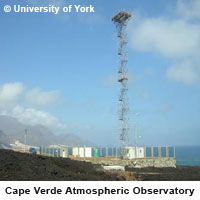
Scientists' understanding of the structure and dynamics of the tropical atmosphere is about to dramatically improve with the opening of a new international atmospheric observatory. Located on the Cape Verde island of São Vicente in the tropical east Atlantic Ocean, the new observatory will monitor and measure changes in the chemical, biological and physical composition of the tropical ocean and the air immediately above it, which is known as the marine boundary layer. The aim is to better understand how the ocean and atmosphere interact and how this impacts upon climate change. The observatory is partly funded by the Leibniz Institute of Marine science through the EU TENATSO (Tropical Eastern North Atlantic Time-Series Observatory) project, and by the UK National Environment Research Council. Tropical oceans cover about one third of the Earth's surface and the air immediately above them contains very high levels of the main atmospheric oxidant known as hydroxyl radicals. The radicals act as a cleaning agent, breaking down greenhouse gases such as methane and nitrous oxide. These contribute to global warming almost as much as carbon dioxide. About 75% of methane removal is thought to occur in the tropics. However, to date, very few scientific studies have been carried out in this region, the focus being more on what is happening at the poles than in the tropics. 'The tropical marine boundary layer acts as an engine room for the self-cleansing of the Earth's atmosphere, but we know little about what's going on there,' says Dr Lucy Carpenter from the University of York, the lead scientist of the TENATSO project. 'These regions are also a 'net sink' for low-level ozone and many dangerous greenhouse gases; that is, where they are broken down, rather than created. The potential for atmospheric and oceanic change is large in this region, so the information we get from the observatory will be invaluable,' she added. The tropical sea is also one of the places where sea-surface temperatures are rapidly changing, lowering amounts of phytoplankton which soak up large amounts of carbon dioxide. This results in differing levels of trace gases being present in the atmosphere. 'Major changes are going on in this region and it is therefore timely that we can now directly observe these changes both on the ground and at the sea-surface,' says Professor Wallace, who coordinates the TENATSO project. In addition to the on-land facilities, the observatory will install an 'ocean station' - a network of buoys and moored instruments - about 70 kilometres offshore. The station will monitor the temperature, salinity and nutrient content of the sea water, as well as levels of carbon and oxygen and the productivity of marine organisms such as phytoplankton (tiny floating plants).
Countries
Germany, United Kingdom