


Scientists must engage in dialogue, says Professor Higgins
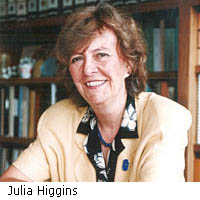
Researchers must engage the public in a dialogue about science and the way it is applied if they are to gain the public's trust, Professor Dame Julia Higgins told her audience at a talk in Brussels on the responsibility of being a scientist. The event was organised by CLORA, the French 'Club of Associated Research Organisations'. Professor Higgins is Principal of the Faculty of Engineering at Imperial College in London, where she carries out research into the behaviour of complex materials, particularly polymers. She is Chair of the UK's Engineering and Physical Sciences Research Council, and until recently was Foreign Secretary of the Royal Society, the UK's scientific academy. The public funds science through its taxes and also suffers the risks and consequences of science when it is applied in their every day lives, Professor Higgins noted. It is hardly surprising therefore that in many countries of the world, members of the public are increasingly demanding a say in what is being done in their name and with their taxes. According to Professor Higgins, the challenge for scientists is to foster a climate of transparency and engage the public in a meaningful dialogue about their work. 'We have moved on from the 'public understanding of science' model where the scientist speaks and the public listens,' she said. 'We need to train scientists to be able to enter into a constructive debate with the public.' On the other hand there is still a need to educate the public about science, and Professor Higgins presented a selection of the Royal Society's activities in this field. One particularly successful scheme is the MP (Member of Parliament) - Scientist twinning project. A young scientist spends time shadowing an MP and learning about how the Parliament functions, and in return the MP spends time in the scientist's lab and even gets to carry out some experiments. The project has been a huge success, with both scientists and MPs lining up to participate, and last year the scheme was extended to include Members of the European Parliament as well. Another success highlighted by Professor Higgins was the Dialogue Programme, which brings together scientists, interest groups and members of the public to discuss a given issue in the context of a facilitated debate. Where relevant, the outcomes of these discussions are then passed on to decision makers, thereby giving the process added value for all participants. The Royal Society also runs training courses on media and communication skills. These teach scientists how to convey their work in a concise, jargon-free way, and how to communicate effectively in a range of media including print, radio and television. While there were good short term reasons for engaging the public in a dialogue on science, for Professor Higgins there is also a very good long term reason, namely getting children excited about science. 'The most important reason for public engagement has to be to encourage young people to become scientists,' she concluded. Professor Higgins' remarks are very much in line with EU policy on science communication; the grant agreement for FP7 states that, 'the beneficiaries shall, throughout the duration of the project, take appropriate measures to engage with the public and the media about the project.' In addition, the European Commission has just published a book on science communication. 'Communicating European Research 2005' brings together the outcomes of the conference of the same name that was held in Brussels just over a year ago.
Countries
United Kingdom