


Research gets underway at UK's new synchrotron facility
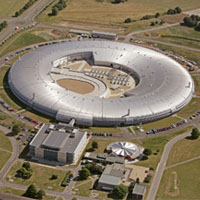
The UK has opened the doors to a brand new synchrotron facility, the largest science facility to be built in the UK for 30 years. The Diamond Light Source houses one of the brightest sources of light in the world, and will enable scientists to find out more about the structure of matter at the molecular and atomic scale. Research groups from the universities of Durham, Oxford, Leicester and London have been selected as the first users of the synchrotron, and will provide the feedback needed for the fine-tuning of the first experimental stations before Diamond is opened up to international research teams. The initial users are investigating topics as diverse as sensors, cancer drugs, electronic data storage, and the solar system. David Eastwood, a postgraduate student at the University of Durham, will be using Diamond's x-rays to examine in detail new sensors to be used in computer components for 'reading' the magnetic information stored in its memory. The research is expected to aid the development of smaller and more sensitive sensors, able to cope with the ever-increasing demand for higher performance computers and electronic equipment. Professor Dave Stuart of the University of Oxford will use the facility to visualise the structure of a protein molecule found in our cells, which is implicated in the development of diseases such as cancer. His research will contribute to the design of more effective drugs to combat certain types of cancer. The facility works by firing electrons into an accelerator. The electrons are then boosted in the small synchrotron and injected into the storage ring. Magnets in the large ring bend and focus the electrons and they are accelerated to near light-speeds. The energy lost appears down the beamlines as highly focused light at x-ray wavelengths. The facility cost GBP 260 million (€394 million) to build, and was financed principally by the UK Government, with support from the Wellcome Trust. Phase 1 included the construction of seven beamlines. A further 15 beamlines will be added under phase 2 of the project, with the last one being in place by 2011. UK Prime Minister Tony Blair visited the Diamond Light Source in November 2006, emphasising the importance of science for the future competitiveness of the UK. 'This new world-class facility shows the importance this country attaches to science and scientists. Our future prosperity rests more than ever before on the hard work and genius of our scientists and how we harness their research to deliver improvements in all our lives. This is exactly what Diamond Light Source will help us achieve in many fields, from developing new drugs to tackling climate change,' said Mr Blair. Diamond will replace the Synchrotron Radiation Source (SRS) in Daresbury, Cheshire, which is due to close at the end of 2008. For some time, many scientists in the UK have been travelling to the European synchrotron in Grenoble, France. The European Synchrotron Radiation Facility (ESRF) is financed by 18 European countries. The biggest contributor is France, which meets 27.5% of the project's costs, followed by Germany (25.5%), Italy (15%) and the UK (14%). The budget for 2007 is €80 million. Around 3,500 researchers use the facility every year.
Countries
United Kingdom