


JRC radar system to provide early warning of volcanic activity in Stromboli
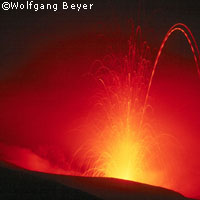
The European Commission's Joint Research Centre (JRC) has announced that it is to provide a helping hand to the Italian authorities in monitoring the movements of the volcano Stromboli. The decision comes following the latest eruptions of the volcano on 27 February, which sent flaming streams of lava flowing into the sea. Using the linear synthetic aperture (LISA), a high resolution radar system, the JRC institute at Ispra will monitor the ground movements on the north-west flank of the volcano. LISA will measure any movement in real time, providing updated accurate displacement maps every 10 minutes. The system will also perform measurements on areas extending from a few metres to a few kilometres to provide close-up views of sections of particular interest. Other functionalities include 24 hour operability, remote observation and maximum flexibility in terms of viewing capacity and frequency of observation. The maps produced by the radar are expected to provide the Italian authorities with early warnings of volcanic activity, enabling them to move quickly to alert the local populations and clear zones at risk. This is not the first time that LISA has been used at Stromboli. In spring 2003, the Italian department of civil protection called on the services of the JRC and its innovative radar system following the eruption of the volcano. LISA has also been used to monitor deformation in dams and bridges, displacement in historical buildings, landslides, subsidence and other ground movements.
Countries
Italy