


160,000 year-old tooth provides clue to emergence of modern man
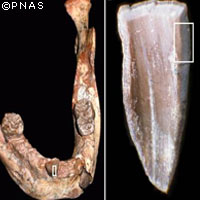
Homo sapiens living 160,000 years ago had life spans much like our own, a team of international scientists has revealed. Thanks to the tooth of an ancient homo sapien child found in the Jebel Irhoud caves in Morocco, and the technology supplied by the European Synchrotron Radiation Facility (ESRF) in France, scientists found that childhood in the Old Stone Age lasted for the same amount of time as that of children living today. Published in the March edition of in the Proceedings of the National Academy of Sciences (PNAS), the findings contrast with previous studies which suggested that early homo sapiens were likely to have had a shorter childhood period, similar to that of primates like gorillas and chimpanzees. Scientists, until now, believed that modern humans only emerged 20,000 to 30,000 years ago. The new study pinpoints the date of their appearance to more than 100,000 years earlier. Teeth can tell us a lot about the evolution of man, since their growth matches other aspects of primate growth and development. The research team led by scientists from the Max Planck Institute for Evolutionary Anthropology and the ESRF used x-ray synchrotron microtomography to count the growth lines within the tooth specimen to establish its owner's age, in a similar way to counting the rings on a tree trunk. They established that the child to whom the tooth belonged was almost eight years old. Unlike earlier fossil humans, which showed shorter and faster tooth growth similar to that of chimpanzees, this new research shows that the teeth of child homo sapiens living 160,000 years ago grew much more slowly, suggesting a longer childhood span. The researchers used synchrotron light at the ESRF and combined a new technique called phase imaging with developmental analysis. 'It is the first non-destructive approach to characterise dental development with a high degree of precision, as synchrotron images reveal microscopic internal growth lines without damage to the sample,' explained Paul Tafforeau, one of the authors and developer of the virtual dental paleohistology using synchrotron light.
Countries
Australia, Germany, France, Morocco, United Kingdom