


Marie Curie Fellows propose mandate for media
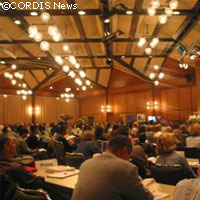
Some of them may still be formulating their scientific theories, but the views of young researchers on science in the media and researcher mobility are already well thought out, and were articulated clearly by a group of Marie Curie Fellows invited by the European Commission to attend a meeting of Nobel Laureates taking place in Lindau, Germany, between 1 and 6 July. The Marie Curie Actions, funded under the EU's framework programmes for research, provide financial support for individual researchers wishing to spend time in another country to pursue research activities. The thinking behind them is that this mobility contributes to the transfer of research competences, the broadening of researchers' career prospects and, ultimately, excellence in European research. Some 18 Nobel Laureates are in Lindau meeting over 560 young scientists from 62 countries. The Fellowship holders were asked by a representative from the European Commission's Research DG to be 'ambassadors' for the Marie Curie initiative, and instructed by Rainer Gerold, representing the President of the Council for the Lindau Nobel Laureate Meetings, to 'make the most of this opportunity, which will not be given to you every day.' Asked what they would like from the media, the Marie Curie Fellows had a number of ideas. 'We expect that when we give information to journalists, it will be transferred to society in a way that people will understand. They must know that their money is being spent on things that will benefit them,' said one. 'We would like you to make scientists appear more appealing!' said another. Depictions of scientists in the media often fail to show the young and dynamic people working in science, she explained. With the microphone now passing freely and quickly from one fellow to the next, another young scientist asked journalists to be careful about what messages they transmit to the general public, warning against creating hype or provoking fear. 'Maybe it's sometimes our fault,' interjected another Fellowship holder. 'We have to explain things at the right level as well. We have to learn how to do this.' Two Fellows suggested ways in which the media could help scientists with their research. The media could encourage the general public to come forward and participate in clinical trials. Many are reluctant to take part in the least invasive of trials, worried about side effects, she said. The media could also help researchers to ensure that they know about all relevant opportunities. There are so many funding programmes available that it is often difficult to stay on top of all the information out there, said one Marie Curie Fellow. By nature of the Marie Curie Fellowships, all Fellows are currently spending time outside of their home countries. Asked by CORDIS News how they are gaining from this in a way that could not be replicated in their home countries, one recipient emphasised the opportunity to work in prestigious research institutions, and the way in which a change broadens the mind. 'I spent 10 years in Marseilles. After a while, you meet the same people and start thinking in one way,' she said. Spending time in the US has increased her knowledge and enabled her to see another way of thinking. 'Every day everything was new for me for the first year,' she added. A German Fellow based in the UK spoke of how mobility enables knowledge to 'travel'. If I acquire knowledge in the UK, I can take it back to Germany,' she said. These Marie Curie Fellowships were funded under the EU's Sixth Framework Programme (FP6), which had a budget of €1.58 billion for the initiative over four years. Under FP7, which will run for seven years, the budget has increased by 62% to €4.73 billion.