


Walking robot takes to the hills
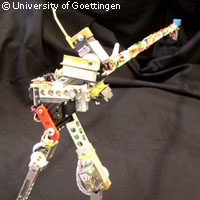
EU funded researchers have developed a robot which is able to learn how to walk on different surfaces and go up and down slopes without falling over. Although walking comes naturally to us, it in fact requires careful coordination of the movements of our joints and the balance point of the torso. Furthermore, different gaits are needed for different environments; walking across sand is different from walking on ice, for example. This latest piece of research involves a robot called RunBot, which already holds the world record in speed walking for dynamic machines. Writing in the journal PLoS Computational Biology, a team of scientists from Germany and the UK explain how the robot's hierarchical levels of control now allow it to navigate across a range of terrains. On lower control levels, movement is based on reflexes driven by sensors. Here control circuits ensure that joints are not overstretched, or that the next step is initiated once the foot touches the ground, for example. Higher centres of organisation are not activated unless a change of gait is needed. In humans, these processes are triggered by the brain, while the robot relies on an infrared 'eye' linked to a simple neural network. A video accompanying the paper shows the robot learning how to walk up a slope. It starts by showing a human hand place RunBot at a short distance from the bottom of a slope. The robot walks towards the slope without any problem, but once on the slope, it soon topples over backwards. The second and third attempts end in the same way. However, on attempt four the robot responds to the slope as a human would, leaning forwards slightly and shortening its steps, and making it to the top of the slope without mishap. In other words, the connection between RunBot's eye and the sites of movement control are strengthened, and from now on, when the eye detects a slope, the robot will adjust its gait accordingly. EU funding for the research came from the PACO-PLUS (Perception, Action and Cognition through Learning of Object-Action Complexes) project, which is financed by the IST (Information Society Technologies) priority of the Sixth Framework Programme (FP6).
Countries
Germany, United Kingdom