


JRC forecasts slight rise in EU crop harvest
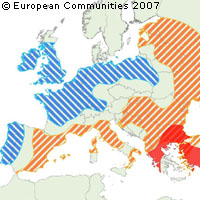
The European Commission's Joint Research Centre has used its crop yield forecasting system to predict that this year's cereal harvest in the EU will rise slightly compared to 2006. However, it will remain 1.6% below the average of the last five years. The quantitative forecasts are produced on a regular basis by the JRC to support the EU's Common Agricultural Policy. They cover Europe's principal crops, including wheat, grain maize, rape seed, sunflower, sugar beet and potato. The forecasts are calculated using agro-meteorological model outputs and satellite indicators, combined with time series trend analyses. Across the EU, this year's growing season trend has been exceptionally good with a mild winter and hot spring temperatures boosting crop growth. However, this year's forecasts indicate that droughts, heat waves and excessive rain across Europe have brought mixed results. Northern regions have been particularly hit with 'unseasonably high' rainfall over the last two months throughout the North Atlantic and North Sea region, spoiling first harvests in the Belgium, Denmark, Luxembourg, the Netherlands, UK and Norway, as well as the northern parts of France, Germany and Poland. At the same time, heat waves and drought spells have had a detrimental effect in Eastern countries, especially around the Black Sea region. In Romania, for example, a heat wave that started in May will likely cut wheat yields by 20.1% below the five-year average. In Bulgaria barley yield will be down 14.6% and for maize the decrease could be as much as 40%. 'Unseasonably high temperatures of 2 to 4 degrees above the seasonal average across the growing season certainly had an impact in central and eastern Europe and the Balkan region,' says the JRC. 'An extreme heat wave is still under way in Hungary, Bulgaria and Romania where both winter and summer crop yields are being affected.' The JRC estimates that Member States should produce 276 million metric tonnes of cereals this year. This 10 million metric tonnes more than last year but 1.6% or 5 million metric tonnes below the average. As for individual crops, overall durum wheat yields should be up slightly compared with last year, with the EU crop forecast predicting an increase of 13.5% more than the five-year average. Potato yields are expected to increase by 8.1%, while rape seed and sunflower yields across the EU will drop by 5.1% and 3.4% respectively.