


Taking the Universe's temperature
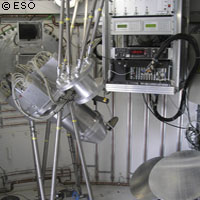
The world's largest bolometer camera for detecting extremely cold astronomical objects is now in operation. Built by scientists at the Max Planck Institute for Radioastronomy (MPIfR), the camera will enable scientists to study faraway galaxies in much greater detail. 'A large fraction of all the gas in the Universe has extremely cold temperatures of around minus 250°Celsius, a mere 20 degrees above absolute zero,' says Karl Menten, director at the MPIfR. 'Studying these cold clouds requires looking at the light they radiate in the submillimetre range, with very sophisticated detectors.' Dubbed LABOCA, the camera is in many ways like a large thermometer. It consists of an extremely thin foil that absorbs light. Any change in the intensity of the incoming radiation can cause slight changes in the foil's temperature. This is registered using sensitive electronic thermometers. But in order to pick up slight temperature fluctuations, the camera must itself be cooled to below absolute zero (-272.85)°C. This requires using liquid helium, which is no simple task given that the camera is in operation at the Atacama Pathfinder Experiment (APEX) telescope, which is located at an observatory on the 5,100 metre-high Chajnantor plateau in the Chilean Andes. Helium solidifies under great pressure. Being placed at such a high altitude does however have advantages. Earthbound observatories often have difficulties detecting cold objects in space because of the weak temperature radiation they emit, which is absorbed by water vapour in the Earth's atmosphere. The high altitude of the observatory where the camera is located means that the radiation signals from space are less obscured, although the heat from the Earth's atmosphere still remains a hundred thousand times more intense that the signals from distant galaxies. Special software is therefore used to filter the radiation signals from these atmospheric disturbances. Several astronomical observations have already been conducted using LABOCA. Scientists say that the camera has huge potential: 'LABOCA is the first camera that will allow us to map large areas on the sky with high sensitivity,' says Giorgio Siringo from MPIfR, a member of the LABOCA team. Furthermore, given its very wide field of view, the camera is expected to complement the APEX telescope in finding and observing galaxies in greater detail.