


Study reveals changes in Arctic Ocean circulation
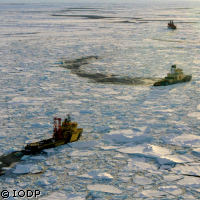
Until recently, the circulation of the Arctic Ocean was driven by the formation of sea ice rather than the inflow of North Atlantic deep water, as is the case today. This is the conclusion of a study by German scientists which is published in the new journal Nature Geoscience. Human activities are already having an effect on the Arctic Ocean, which has been identified by the Intergovernmental Panel on Climate Change (IPCC) as being particularly vulnerable to climate change. Investigating how the region responded to changes in the climate in the past is vital to boosting our understanding of current changes. The latest findings are based on geochemical analyses of sediment cores taken from the depths of the Arctic Ocean as part of the EU-funded ECORD (European Consortium for Ocean Research Drilling) project. The scientists were particularly interested in changes in the isotope ratio of the element neodymium. Neodymium has different isotope ratios depending on the age and type of rock. When rocks are weathered, the element is washed into the sea, where it provides information on the sources of the water in the ocean. The cores enabled the researchers to study changes in the sources of water in the Arctic Ocean going back 15 million years. The scientists were surprised to find that the isotope signature for much of the history of the ocean is very different from the signature found today. The isotope ratios in much of the core correspond to basalt rocks such as those found in the Kara Sea area. This suggests that for most of the last 15 million years, the seawater above the sediments came from within the Arctic Ocean itself. In contrast, today much of the deep water in the Arctic Ocean flows in through the Fram Strait from the Atlantic. So how did the neodymium end up on the sea floor? 'During sea ice formations the salt of the sea water freezes out and is rejected, thereby forming highly saline brines, which were denser than the surrounding sea water,' explained Martin Frank of the Leibniz Institute for Marine Sciences, one of the authors of the paper. 'These brines sank and transported the dissolved Nd [neodymium] isotope signature of the basalts to the sea floor where the sediment cores were recovered.' The sediments show that it is only in the past 400,000 years that the circulation has changed. Nowadays, Russian rivers deliver large amounts of freshwater to the surface of the Arctic Ocean, thereby preventing the formation of deep water.
Countries
Germany